Author: Jeremy H. Carroll
Date: 2026-02-22
Type: Blog post (technical audience, non-specialist)
The problem everyone has
You’re reading a report. It’s 200 pages. Each section was written by a
different person, or generated by a different model, or pulled from a different
database. Every section looks reasonable on its own. The question is: do they agree with each other?
This isn’t a hypothetical. It’s the daily reality of:
- Intelligence analysis. Field reports from different sources, different
languages, different classification levels. Each report is locally coherent.
But do they glue into a consistent global picture? - Scientific literature. Paper A claims X. Paper B claims Y. Both are
peer-reviewed. But X and Y, when combined with a third result Z, produce a
contradiction that no individual paper reveals. - AI-generated content. You ask an LLM to write a specification, then an
implementation, then tests. Each artifact looks correct. But the specification
says one thing, the implementation does another, and the tests pass because
they test the wrong thing. - Regulatory compliance. Local rules at the department level. State-level
overrides. Federal requirements. Each layer is internally consistent. But
do they compose without contradiction?
The common structure: local consistency does not guarantee global consistency. You can check every piece individually and still miss the
contradiction that lives in the gaps between pieces.
What currently exists
The tools we have for this problem fall into two categories:
Manual review. A human reads everything and holds the contradictions in
their head. This works for small corpora. It does not scale. It is also
vulnerable to the reviewer’s own blind spots — if you don’t know enough about
the domain, you can’t detect a contradiction between two claims that both
sound plausible.
Keyword/semantic search. Tools like full-text search, embeddings, or
knowledge graphs can find related claims. But finding related claims is not
the same as detecting contradictions. Two claims can be semantically similar
and logically contradictory. Two claims can be semantically distant and
logically incompatible via a chain of intermediate implications.
Neither approach measures the degree of inconsistency across a structured
collection. Neither tells you where the inconsistency lives — which specific
pair of adjacent claims fails to agree.
The mathematical insight
There is an old mathematical structure that captures this problem exactly. It
comes from algebraic topology, and it’s called a presheaf.
Don’t run. The idea is simple.
A presheaf is a way of assigning data to the parts of a structure, along with
rules for how the data on overlapping parts should agree. If the data agrees
everywhere, the presheaf “descends” — the local pieces glue into a consistent
global picture. If the data doesn’t agree, the presheaf has a coboundary —
a measure of gluing failure at each joint.
Concretely: imagine you have a graph. Each node carries a claim (a number, a
vector, a probability distribution). Each edge connects two claims that should
be compatible. The coboundary at each edge is the difference between what one
claim says and what the adjacent claim says, after applying the appropriate
translation rule.
The coboundary norm is the total gluing failure across the entire graph. For each edge connecting nodes A and B, we
measure how much their claims differ. The total is:
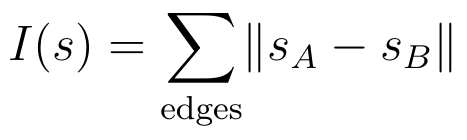
If $I(s) = 0$: perfect consistency. Every local claim agrees with its neighbors.
If $I(s) > 0$: inconsistency. And the per-edge breakdown tells you exactly
where the gluing fails.
This is where it gets interesting. You might ask: why the sum of absolute
differences? Why not the maximum difference? Why not the sum of squared
differences? These are all reasonable-sounding alternatives.
It turns out there is no choice. I proved a theorem — the ℓ¹ Rigidity Theorem
— showing that if you want a consistency diagnostic that satisfies five
properties, the formula above is the only one that works (up to a single
scaling constant).
The five properties are:
- Locality. The diagnostic is a sum over edges. You can compute it by
checking each joint independently. - Faithfulness. An edge contributes zero if and only if the two claims
actually agree at that edge. - Tight monotonicity. If you apply a contraction (lossy transformation)
to all claims, the diagnostic cannot increase — and for some contractions,
it decreases by exactly the contraction factor. - Shift invariance. Adding the same constant to every claim doesn’t
change the diagnostic. Only the differences matter, not the absolute
values. - Naturality. The diagnostic is the same whether you compute it on the
original structure or on a local unfolding (covering space) of that
structure.
Any diagnostic satisfying all five is proportional to the ℓ¹ coboundary norm.
The sum of squares fails property 3. The maximum fails property 1. Non-uniform
weights fail property 5. There is no room for aesthetic preference; the
diagnostic is forced by the requirements.
What I built with it
I built a verification system — the Omega Engine — that treats a codebase (or
any structured collection of claims) as a presheaf and computes the coboundary
norm in real time.
When I write a mathematical assertion in a document, the system checks whether
it is consistent with every other assertion it can see. When the coboundary
norm is low, the claims glue. When it spikes, something contradicts something
else, and the per-edge decomposition tells me which pair of claims is
responsible.
This caught 11 of my own errors during development — claims that sounded
correct individually but contradicted other claims elsewhere in the system.
Each time, the coboundary norm flagged the inconsistency before I noticed it
myself.
Where this applies beyond code
The mathematics doesn’t know what the “claims” are. It only knows the graph
structure and the gluing rules. This means the same tool works for:
Intelligence fusion. Each source is a node. Edges connect sources reporting
on overlapping topics. The coboundary norm measures how much the sources
disagree, weighted by the translation rules between their reporting frameworks.
A high coboundary norm on a specific edge means two sources are contradicting
each other on a specific topic — which is either an error or deliberate
disinformation.
LLM verification. Each generated artifact (spec, code, test, documentation)
is a node. Edges connect artifacts that make overlapping claims about the same
system. The coboundary norm detects when the spec says X, the code implements Y,
and the test verifies Z — even though each artifact individually looks correct.
Scientific corpus analysis. Each paper is a node. Edges connect papers that
address overlapping experimental conditions or theoretical predictions. The
coboundary norm measures the total inconsistency across a body of literature,
and the per-edge decomposition identifies exactly which pairs of papers
disagree.
Regulatory compliance. Local, state, and federal regulations form a
hierarchical graph. The coboundary norm measures where the rules contradict
across levels — the gaps that create legal ambiguity and compliance risk.
What I’m not claiming
I want to be precise about what the theorem does and doesn’t say:
- This does not solve NP-hard problems. It classifies obstructions; it does
not remove them. - This does not detect lies. It detects inconsistency. A perfectly
consistent collection of lies has coboundary norm zero. The tool catches
contradictions, not fabrications. - The scaling theorem is finite-time only. For dynamical systems, the
obstruction is guaranteed to be detectable over a finite time window. In the
long run, systems may thermalize and the signal disappears. - This is mathematics, not philosophy. The framework applies to presheaves
over finite posets with Banach-space stalks. It does not apply to
consciousness, morality, or the meaning of life.
The paper
The formal proofs are in a companion paper: Single Obstruction Theory: Projection Nonlinearity, ℓ¹ Rigidity, and Density Scaling. It proves three theorems:
- The obstruction created by projection (factorization) is structural and
cannot be removed by embedding in a larger system. - The ℓ¹ coboundary norm is the unique diagnostic satisfying five axioms.
- The per-bond obstruction density is bounded below over a finite time window
whose duration does not shrink with system size.
The paper is currently in preparation for arXiv submission.
Why I wrote this
I have spent 30 years studying physics. Not as a professor — as a student, a
practitioner, someone who uses mathematical tools to solve real problems. For
the last two years, I have been building a system that uses AI to help with
mathematical research, and one of the hardest problems is verifying that the
AI’s output is correct.
The coboundary norm is the answer I found. It doesn’t tell you whether any
single claim is true. It tells you whether a collection of claims is
internally consistent. That turns out to be the right question — because
inconsistency is detectable, while individual falsehood often isn’t.
I live in Atlanta. I’m looking for collaborators and for organizations that
care about verification of AI-generated content, intelligence fusion, or
formal compliance checking. If any of this resonates, I’d like to hear from
you.
Jeremy H. Carroll is an independent researcher in Atlanta, Georgia. His work focuses on mathematical verification of structured claims using presheaf cohomology. Contact: blog@ooutwire.com