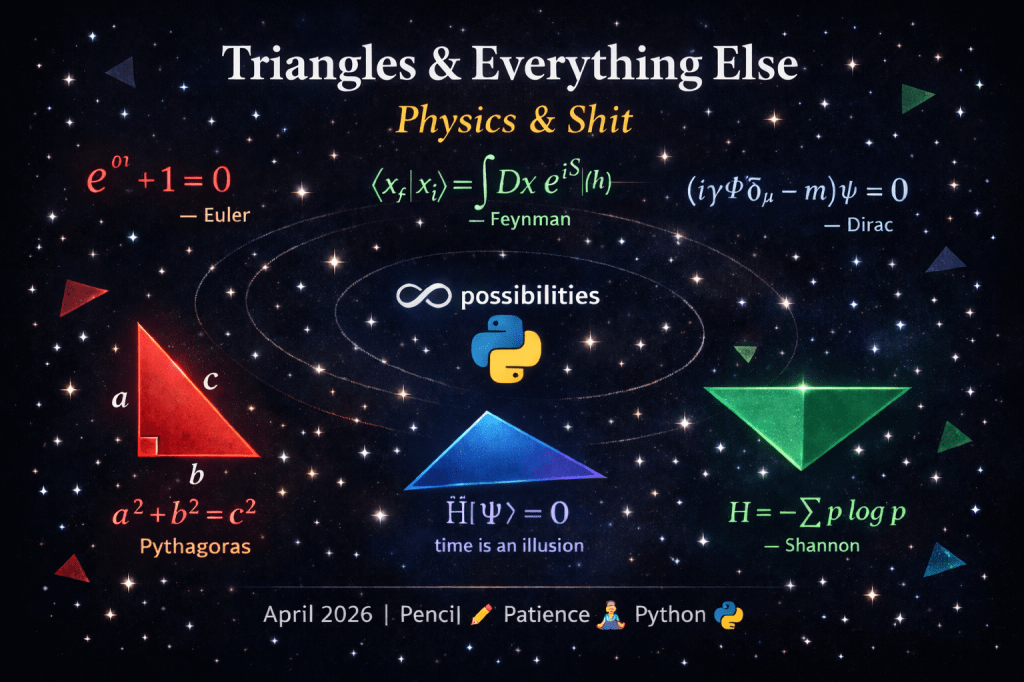
Triangles & Everything Else — Physics, Math, Mind & Shit
2026 — Class Begins 01 April
Course Synopsis
256 lectures (~400 hours)
4 volumes × 64 lectures (Option A — the course is intentionally block-structured and cumulative)
Core thesis: the triangle is the minimal closed relational structure. From this primitive we build a unified sequence: geometry → probability → linear algebra → quantum mechanics → relativity/fields → information/computation → deep foundations and synthesis.
This document contains the full detailed lecture list. The top section exists to make the course navigable.
The 3-Track System (choose your lane, or run all three)
Every lecture is tagged with one or more track labels:
- [P] Core Physics Track (required)
The “physics-first” path: measurement, dynamics, symmetry, quantum theory, spacetime, fields, and the major physical formalisms. - [F] Formal Systems Track (supporting / optional)
The mathematics + computation that turns the physics into something you can prove, compute, and generalize: linear algebra, probability, information, logic, computation, category-style thinking (kept practical). - [M] Mind & Meaning Track (optional seminar layer)
Consciousness/observer questions, philosophy-of-physics, and interpretive synthesis. This track is explicitly optional and can be taken as end-of-volume seminar sessions or capstone discussions.
Default recommendation: take all [P], and add [F] when you want deeper control over the machinery. Add [M] when you want the “why does observation exist at all?” layer.
Volume Structure (Option A)
Each volume is 64 lectures, designed to be internally coherent and to end with a capstone checkpoint.
| Volume | Focus | What you can do by the end |
|---|---|---|
| I. Foundations | triangles → measurement → probability → linear algebra → complex numbers → symmetry | speak the core language of modern physics; compute with vectors, amplitudes, and invariants |
| II. Quantum Mechanics | postulates, states/ops, measurement, spin, entanglement, information | solve canonical QM problems; reason cleanly about measurement, superposition, and entanglement |
| III. Relativity & Fields | SR/GR essentials, fields, particles-as-representations, triangulated spacetime intuition | move between geometric and field descriptions; connect symmetry to dynamics and spacetime structure |
| IV. Information, Computation & Synthesis | information foundations, computation, limits, unification tools, capstone synthesis | understand what can/can’t be predicted/computed; integrate physics with formal constraints and meaning |
Learning Outcomes (what “done” looks like)
By completing the Core Physics Track [P], you will be able to:
- Translate physical claims into invariants, symmetries, and state descriptions.
- Solve standard problems in QM (states, operators, measurement, two-level systems, simple potentials).
- Explain (and compute) how relativity constrains measurement, simultaneity, and dynamics.
- Use linear algebra + probability as native tools for physical reasoning.
- Connect information and computation limits to what physics can, in principle, say.
By adding [F], you will also be able to formalize proofs and build small computational models/simulations.
By adding [M], you will be able to clearly articulate the interpretive stakes of “observer/measurement” without confusing philosophy for physics.
Prerequisites / On-Ramps
- Minimum: comfort with algebra, geometry, and basic functions.
- Helpful: single-variable calculus (you can learn it in-course if you keep up).
- No shame policy: if you’re rusty, take Volume I slowly and treat it as your rebuild.
Course Format & Checkpoints
- Lectures: concept + derivation + worked examples
- Problem Sets: frequent, short, cumulative
- Capstones: at the end of each volume (a longer synthesis set or mini-project)
- Optional seminars ([M]): scheduled at volume boundaries or as discussion sessions
Pacing Options (pick one)
- Standard: 4 lectures/week → 64 weeks (one year-ish cadence)
- Intensive: 6 lectures/week → ~43 weeks
- Deep-work: 2 lectures/week → ~128 weeks (great if you’re building alongside it)
(Detailed lecture-by-lecture outline begins below.)
VOLUME I: FOUNDATIONS (Lectures 1-76)
From triangles to quantum mechanics in 76 lectures.
Part I: The Triangle as Foundation (Lectures 1-6)
1. What is a Triangle? (1.5 hr)
- Three points, three relationships — the minimal closure
- Why two points aren’t enough: lines have no structure
- The triangle as minimal rigid structure: three constraints lock three nodes
- Squares flex, pentagons flex — triangles don’t
- Information content: three points encode a plane uniquely
- The relational view: triangles ARE relationships, not “points in space”
2. The Isosceles Triangle as Nature’s Favorite (1 hr)
- Symmetry: one fold, two equal parts
- Mirror line as first symmetry operation
- Left-right equivalence in physics and perception
- First glimpse of superposition: the symmetric state
- Parity: what changes, what stays the same
3. Ratios: How Triangles Encode Relationships (1.5 hr)
- Similar triangles: same shape, different size
- Ratio as pure information (dimensionless numbers)
- Why physics uses dimensionless ratios: the fine-structure constant α ≈ 1/137
- Building algebra from “this side is to that side as…”
- Scale factor k: the only parameter distinguishing similar triangles
- Proportionality as the language of physics
4. The Pythagorean Theorem as Conservation Law (1.5 hr)
- a² + b² = c² — why do we square?
- Area conservation proof: visual demonstration without algebra
- Dissection proofs: rearranging triangles conserves area
- First hint: nature conserves something (here, area)
- Preview: invariants in relativity, quantum mechanics
- The Pythagorean theorem as the first physics equation
5. The 45-45-90: Our Master Triangle (1 hr)
- Equal legs → maximum symmetry for right triangle
- The √2 as our first irrational companion
- Diagonal of a square: proof that √2 is irrational
- Why “weird” numbers are necessary: continuity demands them
- The 45-45-90 in quantum mechanics: equal superposition |0⟩ + |1⟩
- Normalization factor 1/√2: our constant companion
6. Scaling and Self-Similarity (1 hr)
- Nested triangles: triangles containing triangles
- The Sierpiński triangle: infinite triangles, finite area
- Fractal dimension: log(3)/log(2) ≈ 1.58 — between 1D and 2D
- Scale invariance: same laws at every zoom level
- Power laws in nature: signature of scale-free structure
- Preview: renormalization group, phase transitions
Part II: Trigonometry as Triangle Language (Lectures 7-12)
7. Naming the Ratios: Sin, Cos, Tan (1.5 hr)
- Opposite/hypotenuse = sine: vertical projection
- Adjacent/hypotenuse = cosine: horizontal projection
- Opposite/adjacent = tangent: slope
- For 45-45-90: sin 45° = cos 45° = 1/√2 (memorize this forever)
- For 30-60-90: the other special values
- SOH-CAH-TOA as mnemonic, triangles as meaning
8. The Unit Circle: Infinite Triangles (1.5 hr)
- Hypotenuse locked at 1: the constraint that unlocks everything
- Angle θ as the only free parameter
- Walking around the circle = rotating triangle
- Every point on circle: (cos θ, sin θ)
- Radian measure: arc length = angle × radius
- Full circle = 2π radians = 360°
9. Periodicity and Waves (1.5 hr)
- Sin and cos as height/width while walking the circle
- First wave plots: amplitude, frequency, phase
- sin²θ + cos²θ = 1: Pythagoras on the unit circle
- Orthogonality: sin and cos are 90° out of phase
- Sound waves, light waves, probability waves — all the same math
- The wave equation preview: what oscillates?
10. Addition Formulas: Combining Rotations (1.5 hr)
- sin(α + β) and cos(α + β): geometry of rotation composition
- Proof by rotating triangles
- Double-angle formulas as special case
- Why these formulas matter: Fourier analysis preview
- The rotation matrix: [cos θ, -sin θ; sin θ, cos θ]
11. Inverse Trig: From Ratio Back to Angle (1 hr)
- arcsin, arccos, arctan: undoing the trig functions
- Domain restrictions: why we need them
- Principal values and branches
- The triangle recovers full information from any ratio
12. Polar Coordinates and Complex Preview (1.5 hr)
- (r, θ) vs (x, y): two ways to specify a point
- Conversion: x = r cos θ, y = r sin θ
- Spirals, roses, cardioids
- Preview: complex numbers as r·e^(iθ)
- The triangle in polar form: magnitude and phase
Part III: Probability and Information (Lectures 13-18)
13. Probability Distributions (1.5 hr)
- Sample space, events, probability measure
- Discrete: PMF, binomial, Poisson
- Continuous: PDF, uniform, Gaussian
- The probability simplex: all distributions on n outcomes form a triangle (n=3)
- Expected value and variance
- The 68-95-99.7 rule for Gaussians
14. Conditional Probability and Bayes (1.5 hr)
- P(A|B) = P(A∩B)/P(B): the definition
- Bayes’ theorem: P(H|E) = P(E|H)P(H)/P(E)
- Prior → Evidence → Posterior: the learning triangle
- Medical testing example: why false positives dominate
- Bayesian updating: beliefs evolve with evidence
15. Entropy: Information as Uncertainty (1.5 hr)
- Shannon entropy: H = -Σ p log p
- Maximum entropy = uniform distribution
- Entropy of a coin flip: H(p) = -p log p – (1-p) log(1-p)
- Bits: log base 2
- Information = surprise = reduction in uncertainty
- The triangle: data → model → prediction
16. Mutual Information and Correlation (1.5 hr)
- Joint distributions P(X, Y)
- Marginals and conditionals
- I(X;Y) = H(X) + H(Y) – H(X,Y): shared information
- Independence: I(X;Y) = 0
- The information triangle: I(X;Y) ≤ min(H(X), H(Y))
- Correlation is not causation (yet)
17. KL Divergence: Distance Between Beliefs (1.5 hr)
- D_KL(P||Q) = Σ P log(P/Q)
- Not symmetric: D_KL(P||Q) ≠ D_KL(Q||P)
- Relative entropy: extra bits needed when using wrong code
- Connection to Bayes: D_KL(posterior || prior)
- Information geometry preview
18. The Probability Simplex as Geometry (1.5 hr)
- n outcomes → (n-1)-dimensional simplex
- 3 outcomes → triangle!
- Vertices = certainty, center = maximum entropy
- Fisher information metric: curvature on the simplex
- Geodesics: optimal paths between beliefs
- Preview: quantum states live on a sphere (Bloch), not simplex
Part IV: The Complex Plane (Lectures 19-24)
19. The Imaginary Unit (1.5 hr)
- i² = -1: extending the real line
- Complex numbers z = a + bi
- The complex plane: real axis, imaginary axis
- Every point is a complex number
- Powers of i cycle: i, -1, -i, 1, i, …
20. Complex Arithmetic (1.5 hr)
- Addition: vector addition in the plane
- Multiplication: rotation and scaling
- |z₁z₂| = |z₁||z₂|: moduli multiply
- arg(z₁z₂) = arg(z₁) + arg(z₂): arguments add
- Multiplication by i = 90° rotation
21. Polar Form and Euler’s Formula (1.5 hr)
- z = r(cos θ + i sin θ) = r·e^(iθ)
- Euler’s formula: e^(iθ) = cos θ + i sin θ
- Proof via Taylor series
- e^(iπ) + 1 = 0: the most beautiful equation
- Complex exponential as rotation
22. Roots of Unity (1.5 hr)
- n-th roots of 1: e^(2πik/n) for k = 0, …, n-1
- They form a regular n-gon on the unit circle
- Cube roots: 1, ω, ω² where ω = e^(2πi/3)
- Sum of roots = 0: symmetry
- Roots of unity in quantum mechanics: discrete Fourier transform
23. The Fundamental Theorem of Algebra (1.5 hr)
- Every polynomial of degree n has exactly n complex roots
- Real polynomials: complex roots come in conjugate pairs
- The complex numbers are algebraically closed
- Factoring polynomials completely
- Why complex numbers are “complete”
24. Complex Functions Preview (1 hr)
- f(z) = z²: squaring doubles angles, squares moduli
- Conformal maps: preserve angles
- Analytic functions: complex-differentiable
- Preview: quantum amplitudes are complex numbers
Part V: Calculus (Lectures 25-36)
25. Limits: Approaching Without Reaching (1.5 hr)
- The ε-δ definition (intuition first, rigor second)
- Limits of sequences
- Limits of functions
- One-sided limits
- Limits at infinity
- Why limits are fundamental: instantaneous rate of change
26. The Derivative: Instantaneous Slope (1.5 hr)
- Secant lines → tangent line
- f'(x) = limh→0 – f(x))/h
- Derivative as slope of tangent
- Derivative as instantaneous velocity
- The triangle again: rise/run in the limit
27. Differentiation Rules (1.5 hr)
- d/dx[x^n] = nx^(n-1)
- Product rule, quotient rule
- Chain rule: df/dx = (df/du)(du/dx)
- Derivatives of sin, cos, exp, log
- Building a toolkit
28. Higher Derivatives and Taylor Series (1.5 hr)
- Second derivative: acceleration, concavity
- n-th derivative
- Taylor series: f(x) = Σ f^(n)(a)/n! (x-a)^n
- e^x, sin x, cos x as infinite series
- Approximation: truncating Taylor series
29. The Integral: Accumulation (1.5 hr)
- Area under a curve
- Riemann sums: rectangles approaching truth
- Definite integral: ∫[a,b] f(x) dx
- Properties: linearity, additivity over intervals
- The integral as anti-derivative hint
30. The Fundamental Theorem of Calculus (1.5 hr)
- FTC Part 1: d/dx ∫[a,x] f(t) dt = f(x)
- FTC Part 2: ∫[a,b] f(x) dx = F(b) – F(a)
- Differentiation and integration are inverse operations
- The most important theorem in calculus
- Proof sketch: telescoping
31. Integration Techniques (1.5 hr)
- Substitution: reverse chain rule
- Integration by parts: reverse product rule
- Partial fractions
- Trigonometric substitutions
- Recognizing patterns
32. Multivariable Calculus: Partial Derivatives (1.5 hr)
- Functions of several variables: f(x, y)
- Partial derivatives: ∂f/∂x, ∂f/∂y
- The gradient: ∇f = (∂f/∂x, ∂f/∂y)
- Gradient points uphill, perpendicular to level curves
- Directional derivatives
33. Multiple Integrals (1.5 hr)
- Double integrals: ∫∫ f(x,y) dA
- Iterated integrals: order of integration
- Triple integrals: volumes in 3D
- Change of variables: Jacobian
- Polar, cylindrical, spherical coordinates
34. Vector Calculus: Div, Grad, Curl (1.5 hr)
- Vector fields: F(x, y, z) = (F₁, F₂, F₃)
- Divergence: ∇·F = ∂F₁/∂x + ∂F₂/∂y + ∂F₃/∂z
- Curl: ∇×F
- Physical interpretation: sources, sinks, rotation
- The Laplacian: ∇²f = ∇·(∇f)
35. Line and Surface Integrals (1.5 hr)
- Line integral: ∫_C F·dr — work along path
- Surface integral: ∫∫_S F·dS — flux through surface
- Green’s theorem: line integral = double integral
- Stokes’ theorem: line integral = surface integral
- Divergence theorem: surface integral = volume integral
36. Differential Equations Preview (1.5 hr)
- ODE: equation involving derivatives
- dy/dx = ky: exponential growth/decay
- d²y/dx² = -ω²y: harmonic oscillator
- Solutions: y = Ae^(iωt) + Be^(-iωt)
- Initial conditions determine constants
- Preview: Schrödinger equation is a differential equation
Part VI: Linear Algebra (Lectures 37-48)
37. Vectors: Magnitude and Direction (1.5 hr)
- Vector as arrow: magnitude + direction
- Vector as tuple: (v₁, v₂, …, vₙ)
- Addition: tip-to-tail, component-wise
- Scalar multiplication: stretching
- The vector triangle: v + w = resultant
38. Dot Product: Projection and Orthogonality (1.5 hr)
- v·w = |v||w|cos θ = Σ vᵢwᵢ
- Geometric: projection of v onto w
- Orthogonality: v·w = 0
- The Pythagorean theorem: |v|² = v·v
- Work = force · displacement
39. Matrices: Linear Transformations (1.5 hr)
- Matrix as array of numbers
- Matrix-vector multiplication: linear map
- Examples: rotation, scaling, shear, projection
- Composition: matrix multiplication
- Non-commutativity: AB ≠ BA in general
40. Systems of Linear Equations (1.5 hr)
- Ax = b: the fundamental problem
- Gaussian elimination
- Row echelon form
- Solutions: unique, infinite, none
- Geometric interpretation: intersecting planes
41. Determinants: Volume and Invertibility (1.5 hr)
- det(A): signed volume of parallelepiped
- 2×2: ad – bc
- Properties: det(AB) = det(A)det(B)
- det(A) = 0 ⟺ A is singular
- Cramer’s rule (for small systems)
42. Eigenvalues and Eigenvectors (1.5 hr)
- Av = λv: vector unchanged in direction
- Characteristic polynomial: det(A – λI) = 0
- Eigenvalues λ, eigenvectors v
- Diagonalization: A = PDP⁻¹
- Physical meaning: principal axes, modes
43. Vector Spaces: Abstract Vectors (1.5 hr)
- Axioms: closure, associativity, identity, inverse, distributivity
- Examples: ℝⁿ, polynomials, functions, matrices
- Subspaces: subset that’s also a vector space
- Span: all linear combinations
- Dimension: number of basis vectors
44. Basis and Dimension (1.5 hr)
- Linear independence: no vector is a combo of others
- Basis: linearly independent spanning set
- Every basis has same size = dimension
- Coordinates: components relative to basis
- Change of basis: same vector, different coordinates
45. Inner Product Spaces (1.5 hr)
- Generalized dot product: ⟨u, v⟩
- Axioms: linearity, symmetry, positive-definiteness
- Norm: ||v|| = √⟨v, v⟩
- Cauchy-Schwarz: |⟨u, v⟩| ≤ ||u|| ||v||
- Hilbert space preview: infinite-dimensional
46. Orthonormal Bases and Projections (1.5 hr)
- Orthonormal: ⟨eᵢ, eⱼ⟩ = δᵢⱼ
- Gram-Schmidt process: make any basis orthonormal
- Projection: proj_W(v) = Σ ⟨v, eᵢ⟩eᵢ
- Least squares: minimize ||Ax – b||²
- Fourier series preview
47. Linear Operators and Matrices (1.5 hr)
- Linear operator: T(αu + βv) = αT(u) + βT(v)
- Every linear operator ↔ matrix (given basis)
- Adjoint: ⟨Tu, v⟩ = ⟨u, T†v⟩
- Self-adjoint (Hermitian): T = T†
- Unitary: T†T = TT† = I
48. Spectral Theorem: The Climax of Linear Algebra (1.5 hr)
- Hermitian matrices have real eigenvalues
- Eigenvectors of distinct eigenvalues are orthogonal
- Spectral theorem: A = Σ λᵢ |eᵢ⟩⟨eᵢ|
- Diagonalization in orthonormal basis
- This IS quantum measurement (preview)
Part VII: Classical Mechanics (Lectures 49-56)
49. Newton’s Laws (1.5 hr)
- First law: inertia
- Second law: F = ma
- Third law: action-reaction
- Solving equations of motion
- Examples: projectile, pendulum
50. Energy and Work (1.5 hr)
- Work: W = ∫ F·dr
- Kinetic energy: T = ½mv²
- Potential energy: U (gravity, spring)
- Conservation: E = T + U = constant
- The energy triangle: T ↔ U conversion
51. The Lagrangian: A New Perspective (1.5 hr)
- L = T – U: kinetic minus potential
- Generalized coordinates: q₁, q₂, …
- Action: S = ∫ L dt
- Principle of least action: δS = 0
- Why does nature minimize action?
52. Euler-Lagrange Equations (1.5 hr)
- d/dt(∂L/∂q̇) – ∂L/∂q = 0
- Derivation from δS = 0
- Reproduce Newton’s laws
- But more: handle any coordinates
- Constraints become easy
53. The Hamiltonian: Energy as Generator (1.5 hr)
- Momentum: p = ∂L/∂q̇
- Legendre transform: H = pq̇ – L
- H = T + U: total energy (usually)
- Hamilton’s equations: q̇ = ∂H/∂p, ṗ = -∂H/∂q
- Phase space: (q, p) coordinates
54. Poisson Brackets and Canonical Transformations (1.5 hr)
- {f, g} = Σ (∂f/∂q ∂g/∂p – ∂f/∂p ∂g/∂q)
- {q, p} = 1: the fundamental bracket
- Time evolution: df/dt = {f, H}
- Canonical transformations preserve brackets
- Preview: commutators in QM
55. Oscillations and Normal Modes (1.5 hr)
- Simple harmonic oscillator: ẍ = -ω²x
- Solution: x = A cos(ωt + φ)
- Coupled oscillators: two masses, two springs
- Normal modes: eigenvectors of motion
- Fourier: any motion = sum of modes
56. Noether’s Theorem Preview (1.5 hr)
- Symmetry → conservation law
- Time translation → energy conservation
- Space translation → momentum conservation
- Rotation → angular momentum conservation
- The most beautiful theorem in physics
Part VIII: Statistical Mechanics (Lectures 57-64)
57. Microstates and Macrostates (1.5 hr)
- Microstate: exact configuration of all particles
- Macrostate: observable properties (T, P, V)
- Many microstates → same macrostate
- Entropy S = k log W: count microstates
- The fundamental assumption: all microstates equally likely
58. The Boltzmann Distribution (1.5 hr)
- P(state) ∝ e^(-E/kT)
- Derivation from maximum entropy
- Partition function: Z = Σ e^(-Eᵢ/kT)
- All thermodynamics from Z
- Low T: ground state dominates; High T: all states equal
59. Thermodynamic Quantities from Z (1.5 hr)
- Free energy: F = -kT log Z
- Energy: ⟨E⟩ = -∂(log Z)/∂β where β = 1/kT
- Entropy: S = -∂F/∂T
- Heat capacity: C = ∂⟨E⟩/∂T
- The partition function knows everything
60. Entropy and the Second Law (1.5 hr)
- S always increases (in isolated system)
- Entropy as disorder? As information?
- Maxwell’s demon: information and entropy
- Landauer’s principle: erasing info costs kT ln 2
- The arrow of time
61. The Canonical Ensemble (1.5 hr)
- System + heat bath at temperature T
- Energy fluctuates, temperature fixed
- Canonical partition function
- Fluctuations: ⟨(ΔE)²⟩ = kT²Cᵥ
- Large N: fluctuations negligible
62. Quantum Statistical Mechanics Preview (1.5 hr)
- Bosons: Bose-Einstein statistics, can pile up
- Fermions: Fermi-Dirac statistics, exclusion
- Planck distribution: blackbody radiation
- Fermi sea: electrons in metal
- Why quantum effects matter at low T
63. Phase Transitions (1.5 hr)
- First-order: latent heat, discontinuity
- Second-order: continuous, diverging susceptibility
- Critical point: scale invariance
- Order parameter: distinguishes phases
- Universality: different systems, same exponents
64. The Ising Model: Magnetism from Triangles (1.5 hr)
- Spins on a lattice: +1 or -1
- Energy: E = -J Σ sᵢsⱼ – h Σ sᵢ
- 1D: exactly solvable, no phase transition
- 2D: Onsager solution, phase transition!
- Triangular lattice: frustration and complexity
Part IX: Symmetry and Groups (Lectures 65-72)
65. What is Symmetry? (1.5 hr)
- Transformation that leaves something unchanged
- Examples: rotation, reflection, translation
- Symmetries form a group
- Approximate vs exact symmetry
- Symmetry breaking: the asymmetric world
66. Groups: The Algebra of Symmetry (1.5 hr)
- Definition: closure, associativity, identity, inverse
- Examples: integers under addition, rotations of square
- Abelian vs non-abelian
- Subgroups, cosets
- Homomorphisms: structure-preserving maps
67. Finite Groups and Permutations (1.5 hr)
- Symmetric group Sₙ: all permutations of n objects
- Cyclic groups Zₙ: rotations of n-gon
- Dihedral groups Dₙ: rotations + reflections
- Group multiplication tables
- Every finite group ⊂ some Sₙ (Cayley’s theorem)
68. Continuous Groups: Lie Groups (1.5 hr)
- SO(2): rotations in 2D — the circle
- SO(3): rotations in 3D — not a sphere!
- SU(2): 2×2 unitary matrices with det = 1
- U(1): phase rotations — the circle again
- Lie groups: continuous symmetry groups
69. Lie Algebras: Infinitesimal Symmetries (1.5 hr)
- Generators: infinitesimal transformations
- so(3): angular momentum operators
- Commutator: [X, Y] = XY – YX
- Structure constants: [Xᵢ, Xⱼ] = Σ fᵢⱼₖ Xₖ
- Exponential map: group from algebra
70. Representations: Groups Acting on Vectors (1.5 hr)
- Representation: group → matrices
- Trivial rep: everything → identity
- Faithful rep: injective (no info lost)
- Irreducible rep: no invariant subspaces
- Characters: traces of representation matrices
71. SU(2) and Spin (1.5 hr)
- SU(2): 2×2 unitary, det = 1
- Pauli matrices: σₓ, σᵧ, σᵤ
- Spin-1/2: the fundamental rep
- SU(2) → SO(3): double cover
- Spinors: rotate by 4π to return!
72. Noether’s Theorem: Symmetry = Conservation (1.5 hr)
- Continuous symmetry → conserved quantity
- Time translation → energy
- Space translation → momentum
- Rotation → angular momentum
- Phase rotation → charge (electric, etc.)
- The deepest theorem in physics
Part X: Quantum Mechanics Foundations (Lectures 73-84)
73. The Quantum Postulates (1.5 hr)
- State = vector |ψ⟩ in Hilbert space
- Observable = Hermitian operator
- Measurement → eigenvalue, state → eigenvector
- Probability: |⟨eigenstate|ψ⟩|²
- Time evolution: i ℏ d|ψ⟩/dt = H|ψ⟩
74. The Qubit: Simplest Quantum System (1.5 hr)
- Two-level system: |0⟩ and |1⟩
- Superposition: α|0⟩ + β|1⟩, |α|² + |β|² = 1
- Bloch sphere: state ↔ point on sphere
- The sphere’s triangle: latitude and longitude
- Measurement: collapse to |0⟩ or |1⟩
75. Operators and Observables (1.5 hr)
- Position operator X̂: X̂|x⟩ = x|x⟩
- Momentum operator P̂: P̂|p⟩ = p|p⟩
- In position basis: P̂ = -iℏ d/dx
- Eigenstates of X̂ vs P̂: Fourier duals
- Hermitian: real eigenvalues, orthogonal eigenstates
76. The Commutator and Uncertainty (1.5 hr)
- [X̂, P̂] = iℏ: the fundamental commutator
- Heisenberg uncertainty: ΔX ΔP ≥ ℏ/2
- Non-commuting observables: can’t know both exactly
- Compare: {q, p} = 1 (Poisson) → [Q̂, P̂] = iℏ
- Quantization: replace brackets
Part XI: Quantum Mechanics Development (Lectures 77-88)
77. Wave Functions and Probability (1.5 hr)
- ψ(x) = ⟨x|ψ⟩: amplitude at position x
- |ψ(x)|²: probability density
- Normalization: ∫|ψ|² dx = 1
- Expectation values: ⟨X⟩ = ∫ x|ψ|² dx
- Wave function is not a physical wave
78. The Schrödinger Equation (1.5 hr)
- iℏ ∂ψ/∂t = Ĥψ where Ĥ = -ℏ²/2m ∇² + V
- Time-independent: Ĥψ = Eψ
- Stationary states: ψ(x,t) = φ(x)e^(-iEt/ℏ)
- Superposition of energy eigenstates
- Solving the equation: bound states, scattering
79. Particle in a Box (1.5 hr)
- Infinite potential walls at x = 0, L
- Boundary conditions: ψ(0) = ψ(L) = 0
- Solutions: ψₙ = √(2/L) sin(nπx/L)
- Energies: Eₙ = n²π²ℏ²/(2mL²)
- Quantization from boundary conditions
80. The Harmonic Oscillator (1.5 hr)
- V(x) = ½mω²x²: parabolic potential
- Ladder operators: a = √(mω/2ℏ)(x + ip/mω)
- [a, a†] = 1
- Energy levels: Eₙ = ℏω(n + ½)
- Zero-point energy: E₀ = ½ℏω ≠ 0
81. Angular Momentum in QM (1.5 hr)
- L̂ = r̂ × p̂
- [L̂ₓ, L̂ᵧ] = iℏL̂ᵤ (and cyclic)
- L̂² and L̂ᵤ commute: can measure both
- Eigenvalues: l(l+1)ℏ², mℏ where m = -l, …, l
- Spherical harmonics: Yₗᵐ(θ, φ)
82. Spin: Intrinsic Angular Momentum (1.5 hr)
- Spin is not orbital rotation
- Spin-1/2: two states |↑⟩, |↓⟩
- Pauli matrices represent spin operators
- Spin + orbital = total angular momentum
- Stern-Gerlach experiment: spin is real
83. The Hydrogen Atom (1.5 hr)
- Coulomb potential: V = -e²/r
- Separation in spherical coordinates
- Principal quantum number n
- Energy: Eₙ = -13.6 eV / n²
- Orbitals: 1s, 2s, 2p, 3s, 3p, 3d, …
84. Entanglement: Quantum Correlations (1.5 hr)
- Two qubits: |00⟩, |01⟩, |10⟩, |11⟩
- Product states: |ψ⟩|φ⟩
- Entangled states: can’t factor! e.g., (|00⟩ + |11⟩)/√2
- Bell states: maximally entangled
- EPR paradox: “spooky action at distance”
85. Bell’s Theorem: No Local Hidden Variables (1.5 hr)
- EPR argument: QM is incomplete?
- Hidden variables: pre-determined outcomes
- Bell inequality: constraint on local hidden variables
- QM violates Bell inequality
- Experiments confirm: QM wins, no local realism
86. Measurement Problem (1.5 hr)
- Wave function collapse: when and how?
- The measurement problem: unitary evolution + collapse?
- Interpretations: Copenhagen, Many-Worlds, Bohmian, QBism
- Decoherence: environment-induced classicality
- No interpretation is obviously right
87. The Density Matrix: Mixed States (1.5 hr)
- Pure state: |ψ⟩ or equivalently ρ = |ψ⟩⟨ψ|
- Mixed state: ρ = Σ pᵢ |ψᵢ⟩⟨ψᵢ|
- Expectation: ⟨A⟩ = Tr(ρA)
- Reduced density matrix: tracing out subsystems
- Entanglement ↔ mixed reduced states
88. Path Integrals: Sum Over Histories (1.5 hr)
- Feynman’s formulation
- Amplitude = Σ e^(iS/ℏ) over all paths
- Classical path: stationary phase
- ℏ → 0: classical limit
- The triangle: initial state → path → final state
VOLUME II: RELATIVITY AND PARTICLES (Lectures 89-136)
From Einstein to the Standard Model.
Part XII: Special Relativity (Lectures 89-100)
89. The Principle of Relativity (1.5 hr)
- Galilean relativity: physics same in all inertial frames
- Problem: Maxwell’s equations give c as constant
- Einstein’s postulates: (1) relativity, (2) speed of light c is absolute
- Resolution: space and time must transform together
90. Time Dilation and Length Contraction (1.5 hr)
- Light clock thought experiment
- Time dilation: Δt’ = γΔt where γ = 1/√(1-v²/c²)
- Moving clocks run slow
- Length contraction: L’ = L/γ
- Moving objects shrink in direction of motion
91. Lorentz Transformations (1.5 hr)
- x’ = γ(x – vt), t’ = γ(t – vx/c²)
- Reduces to Galilean for v << c
- Symmetry between space and time
- Inverse transformation: v → -v
- Lorentz group: rotations + boosts
92. Spacetime Diagrams (1.5 hr)
- Minkowski diagram: x horizontal, ct vertical
- World lines: trajectories in spacetime
- Light cones: |x| = ct
- Past, future, elsewhere
- Simultaneity is relative
93. The Invariant Interval (1.5 hr)
- s² = c²t² – x² – y² – z²
- s² > 0: timelike (can reach by traveling slower than c)
- s² < 0: spacelike (can’t reach)
- s² = 0: lightlike (light travels here)
- Proper time: dτ² = dt² – dx²/c²
94. Four-Vectors (1.5 hr)
- Four-position: (ct, x, y, z)
- Four-velocity: uᵘ = dxᵘ/dτ
- Four-momentum: pᵘ = muᵘ = (E/c, p)
- Invariant: pᵘpᵤ = m²c²
- E² = (pc)² + (mc²)²
95. Relativistic Energy and Momentum (1.5 hr)
- E = γmc²: total energy
- E = mc² when v = 0: rest energy
- Kinetic energy: T = (γ-1)mc²
- Momentum: p = γmv
- Massless particles: E = pc (photons)
96. Relativistic Dynamics (1.5 hr)
- Newton’s second law: F = dp/dt
- Four-force: Fᵘ = dpᵘ/dτ
- Relativistic rocket: constant proper acceleration
- Collisions and conservation laws
- Pair production: E = 2mc²
97. Electromagnetism and Relativity (1.5 hr)
- Electric and magnetic fields mix under boosts
- Field tensor Fᵘᵛ: antisymmetric 4×4 matrix
- Maxwell’s equations in covariant form
- Electromagnetic field is a 2-form
- Light is a relativistic necessity
98. Relativistic Quantum Mechanics Preview (1.5 hr)
- Klein-Gordon equation: (□ + m²)φ = 0
- Problem: negative probabilities
- Need for Dirac equation
- Antiparticles as necessity
- QFT as resolution
99. Twins Paradox and Other “Paradoxes” (1.5 hr)
- Twin paradox: who ages more?
- Resolution: acceleration breaks symmetry
- Ladder paradox: length contraction
- Bell’s spaceship paradox
- All “paradoxes” dissolve with careful analysis
100. The Geometry of Spacetime (1.5 hr)
- Minkowski space: flat spacetime
- Metric tensor: ηᵘᵛ = diag(1, -1, -1, -1)
- Geodesics: straight lines
- Preview: curved spacetime = gravity
- Special relativity as prelude to general
Part XIII: The Dirac Equation (Lectures 101-108)
101. The Problem with Klein-Gordon (1.5 hr)
- (∂ₜ² – ∇² + m²)φ = 0
- Second-order in time: two initial conditions
- Probability density can be negative
- Not suitable for single particle interpretation
- Need first-order equation in time
102. Dirac’s Insight: Linearizing the Square Root (1.5 hr)
- E² = p²c² + m²c⁴ → E = √(p² + m²) ?
- Need to factor: E = α·p + βm
- α, β can’t be numbers — must be matrices!
- 4×4 matrices: Dirac matrices γᵘ
- (iγᵘ∂ᵤ – m)ψ = 0: the Dirac equation
103. Dirac Matrices and Spinors (1.5 hr)
- γ⁰, γ¹, γ², γ³: the gamma matrices
- Clifford algebra: {γᵘ, γᵛ} = 2ηᵘᵛ
- Dirac spinor: 4-component column vector
- Not a 4-vector! Different transformation law
- Two spin states × (particle + antiparticle)
104. Solutions of the Dirac Equation (1.5 hr)
- Plane wave solutions: ψ = u(p)e^(-ip·x)
- Four solutions: spin up/down × positive/negative energy
- Negative energy solutions: problem!
- Dirac sea interpretation (historical)
- Modern: antiparticles
105. Spin from the Dirac Equation (1.5 hr)
- Spin operator: S = ℏ/2 Σ where Σ involves γ matrices
- Total angular momentum: J = L + S
- Spin-orbit coupling emerges naturally
- g-factor = 2 (with small QED corrections)
- Electron’s spin: not put in by hand — it emerges!
106. The Positron and Antimatter (1.5 hr)
- Dirac (1928): predicted antielectron
- Anderson (1932): discovered positron in cosmic rays
- CPT theorem: every particle has antiparticle
- C (charge conjugation), P (parity), T (time reversal)
- Matter-antimatter asymmetry: why more matter?
107. Dirac Equation in Electromagnetic Field (1.5 hr)
- Minimal coupling: pᵘ → pᵘ – eAᵘ
- (iγᵘ(∂ᵤ + ieAᵤ) – m)ψ = 0
- Hydrogen atom: relativistic corrections
- Fine structure: energy level splitting
- Lamb shift: QED correction
108. Spinors and Lorentz Transformations (1.5 hr)
- How do spinors transform under boosts/rotations?
- Rotation by 2π: ψ → -ψ (spinors are double-valued!)
- Need 4π to return to original
- SU(2) is double cover of SO(3)
- Spinor representation of Lorentz group
Part XIV: Quantum Field Theory (Lectures 109-120)
109. Why We Need Fields (1.5 hr)
- Particles can be created and destroyed
- Number of particles not conserved
- Need infinite degrees of freedom: fields φ(x, t)
- Classical field theory: Lagrangian density ℒ
- Field equations from action: δS = 0
110. Canonical Quantization of Fields (1.5 hr)
- Field φ(x) and conjugate momentum π(x)
- Promote to operators: [φ̂(x), π̂(y)] = iℏδ(x-y)
- Mode expansion: creation and annihilation operators
- [aₖ, aₖ’†] = δₖₖ’: commutators for bosons
- Fock space: states labeled by occupation numbers
111. The Vacuum and Its Fluctuations (1.5 hr)
- Vacuum state |0⟩: no particles
- But ⟨0|φ̂²|0⟩ ≠ 0: vacuum fluctuations!
- Zero-point energy: ½ℏω per mode
- Infinite sum → need renormalization
- Casimir effect: vacuum exerts measurable force
112. Particles as Field Excitations (1.5 hr)
- One-particle state: |k⟩ = aₖ†|0⟩
- Particles are ripples in quantum fields
- The field is fundamental; particles are derived
- Different fields → different particle types
- Electron field, photon field, quark fields, etc.
113. Interactions and Feynman Diagrams (1.5 hr)
- Free theory: exactly solvable
- Interactions: add terms like λφ⁴
- Perturbation theory: expand in coupling
- Feynman diagrams: pictures of amplitudes
- Vertices, propagators, external lines
114. Quantum Electrodynamics (1.5 hr)
- ℒ = ψ̄(iγᵘ∂ᵤ – m)ψ – ¼FᵤᵥFᵘᵛ – eψ̄γᵘψAᵤ
- Electron, positron, photon interactions
- Fine structure constant: α ≈ 1/137
- Most precisely tested theory in physics
- Anomalous magnetic moment: g – 2
115. Divergences and Renormalization (1.5 hr)
- Loop integrals often diverge
- Regularization: make finite temporarily
- Renormalization: absorb infinities into parameters
- Physical predictions are finite
- Renormalizable vs non-renormalizable theories
116. Gauge Invariance (1.5 hr)
- Local symmetry: ψ → e^(iα(x))ψ
- Requires gauge field: Aᵤ → Aᵤ – ∂ᵤα
- Covariant derivative: Dᵤ = ∂ᵤ + ieAᵤ
- Gauge symmetry dictates interaction form
- The organizing principle of particle physics
117. Non-Abelian Gauge Theories (1.5 hr)
- U(1): abelian (group elements commute)
- SU(2), SU(3): non-abelian
- Yang-Mills theory: gauge fields carry charge
- Gluons interact with gluons
- Asymptotic freedom: coupling decreases at high energy
118. Spontaneous Symmetry Breaking (1.5 hr)
- Mexican hat potential: symmetric but asymmetric minimum
- Choose vacuum: breaks symmetry
- Goldstone theorem: massless bosons
- Higgs mechanism: Goldstone bosons → massive gauge bosons
- How W, Z get mass
119. The Standard Model Lagrangian (1.5 hr)
- SU(3)_c × SU(2)_L × U(1)_Y
- Quarks, leptons, gauge bosons, Higgs
- 19 free parameters
- Everything we know about particles (almost)
- What it doesn’t include
120. Running Coupling Constants (1.5 hr)
- Couplings depend on energy scale
- QED: α increases at high energy
- QCD: αs decreases (asymptotic freedom)
- Grand unification: couplings meet at ~10¹⁶ GeV?
- The energy landscape of physics
Part XV: The Standard Model (Lectures 121-136)
121. Quarks: The Color Triangle (1.5 hr)
- Six quarks: u, d, c, s, t, b
- Three colors: red, green, blue — SU(3) symmetry
      R
     /|\
    / | \
   G--+--B
- Quarks never seen alone: confinement
- Only colorless combinations exist as free particles
- The baryon as a literal color triangle
122. Quantum Chromodynamics (1.5 hr)
- SU(3) gauge theory: 8 gluons
- Gluons carry color (unlike photons)
- Quark-gluon vertex
- Asymptotic freedom at high energy
- Confinement at low energy
123. Hadrons: Baryons and Mesons (1.5 hr)
- Hadrons: composite particles
- Baryons: three quarks (proton = uud)
- Baryons are COLOR TRIANGLES: R + G + B = white
- Mesons: quark-antiquark pairs
- The eightfold way: SU(3) flavor symmetry
124. The Electroweak Force (1.5 hr)
- Weak force: mediates beta decay
- W± and Z⁰ bosons: massive
- SU(2)_L × U(1)_Y → U(1)_EM
- Parity violation: weak force is chiral
- Weinberg angle: mixing
125. The Higgs Mechanism in Detail (1.5 hr)
- Electroweak symmetry breaking
- Higgs doublet: 4 real fields
- Vacuum expectation value: ⟨φ⟩ = v/√2
- 3 Goldstones eaten by W±, Z⁰
- 1 physical Higgs: discovered 2012
126. Fermion Masses and Generations (1.5 hr)
- Yukawa couplings give mass
- Hierarchy problem: why such different masses?
- Three generations: why three?
- CKM matrix: quark mixing
- CP violation
127. Neutrino Physics (1.5 hr)
- Neutrino oscillations: flavor change
- Implies neutrino masses
- PMNS matrix: lepton mixing
- Majorana vs Dirac neutrinos
- Solar, atmospheric, reactor experiments
128. Precision Tests (1.5 hr)
- Electroweak precision at LEP
- Muon g-2: possible new physics?
- Rare decays and mixing
- Standard Model works incredibly well
- But tensions exist…
129. The Higgs Boson (1.5 hr)
- Discovery: July 4, 2012
- Mass: 125 GeV
- Production and decay modes
- Spin-0 confirmed
- Couplings match predictions
130. Beyond the Standard Model: Motivations (1.5 hr)
- Hierarchy problem
- Dark matter
- Dark energy
- Neutrino masses
- Matter-antimatter asymmetry
- Gravity not included
131. Supersymmetry (1.5 hr)
- Boson ↔ fermion symmetry
- Every particle has superpartner
- Solves hierarchy problem
- Gauge coupling unification
- Not yet observed: where is SUSY?
132. Grand Unified Theories (1.5 hr)
- SU(5), SO(10), E₆
- Quarks and leptons unified
- Proton decay predictions
- Gauge coupling unification
- The quest for simplicity
133. Extra Dimensions (1.5 hr)
- Kaluza-Klein: 5D unifies gravity + EM
- String theory: 10 or 11 dimensions
- Large extra dimensions
- Warped extra dimensions
- Why we don’t see them
134. String Theory Overview (1.5 hr)
- Fundamental strings, not points
- Closed strings include graviton
- Critical dimension: 10 (or 11)
- Landscape: 10^500 vacua?
- AdS/CFT: holography
135. The Triangle in Particle Physics (1.5 hr)
- Color: three colors forming triangle
- Generations: three families
- CKM/PMNS unitarity triangles
- Triangle anomalies: must cancel
- Why three is fundamental
136. Open Questions in Particle Physics (1.5 hr)
- What is dark matter?
- Why three generations?
- Why these masses?
- Is there a desert to GUT scale?
- The future of particle physics
VOLUME III: GRAVITY AND INFORMATION (Lectures 137-180)
From curved spacetime to the nature of mind.
Part XVI: General Relativity (Lectures 137-148)
137. Gravity as Geometry (1.5 hr)
- Newton: gravity as force
- Einstein: gravity as curvature
- Equivalence principle: gravity = acceleration
- Free fall is inertial motion
- Geodesics: straightest paths
138. Curved Spaces and Metrics (1.5 hr)
- Manifold: locally Euclidean
- Metric tensor gᵤᵥ: defines distances
- Line element: ds² = gᵤᵥ dxᵘ dxᵛ
- Examples: sphere, hyperbolic space
- Coordinates are labels, not reality
139. Geodesics and Christoffel Symbols (1.5 hr)
- Geodesic equation
- Christoffel symbols: Γᵅᵤᵥ
- Parallel transport
- Geodesic deviation = tidal forces
- This IS gravity
140. The Riemann Tensor (1.5 hr)
- Curvature from parallel transport
- Riemann tensor Rᵅᵦᵤᵥ: 20 components in 4D
- Ricci tensor: Rᵤᵥ = Rᵅᵤᵅᵥ
- Ricci scalar: R = gᵘᵛRᵤᵥ
- Curvature is local, geometry is global
141. Einstein’s Field Equations (1.5 hr)
- Gᵤᵥ = 8πG Tᵤᵥ
- Einstein tensor: Gᵤᵥ = Rᵤᵥ – ½gᵤᵥR
- Stress-energy tensor: matter content
- 10 coupled nonlinear PDEs
- Hardest equations in physics
142. Schwarzschild Black Holes (1.5 hr)
- Spherically symmetric vacuum solution
- Event horizon: nothing escapes
- Singularity: infinite curvature
- No-hair theorem: mass, charge, spin only
- Observational evidence
143. Gravitational Waves (1.5 hr)
- Weak field: linearized gravity
- Wave equation for metric perturbations
- Two polarizations: + and ×
- LIGO detection: GW150914
- New astronomy
144. Cosmology: The Big Bang (1.5 hr)
- FLRW metric: homogeneous, isotropic
- Friedmann equations
- Scale factor a(t): expansion
- Big Bang: a → 0
- Cosmic microwave background
145. Dark Matter and Dark Energy (1.5 hr)
- Galaxy rotation curves: dark matter
- Cosmological constant: dark energy
- ~68% dark energy, ~27% dark matter, ~5% normal matter
- What are they? Unknown
- The cosmological constant problem
146. Hawking Radiation (1.5 hr)
- QFT in curved spacetime
- Particle creation near horizon
- Black holes emit thermal radiation
- Black hole temperature and entropy
- Information paradox begins
147. Regge Calculus: Triangulating Spacetime (1.5 hr)
- Replace smooth with simplicial
- 4-simplices: pentachora
- Curvature → deficit angles
- Einstein-Hilbert → sum over hinges
- The triangle discretizes gravity!
148. Tests of General Relativity (1.5 hr)
- Mercury precession
- Light bending
- Gravitational redshift
- Shapiro delay
- Frame dragging
- All tests passed
Part XVII: Quantum Gravity (Lectures 149-160)
149. The Problem of Quantum Gravity (1.5 hr)
- GR + QM needed at Planck scale
- Planck length: 10⁻³⁵ m
- Naive quantization fails: non-renormalizable
- Need new approach
- What is quantum spacetime?
150. Approaches Overview (1.5 hr)
- String theory: extra dimensions
- Loop quantum gravity: discrete geometry
- Causal dynamical triangulations: Monte Carlo spacetime
- Causal sets: discrete causal structure
- Others: asymptotic safety, non-commutative geometry
151. Loop Quantum Gravity (1.5 hr)
- Canonical quantization of GR
- Ashtekar variables
- Spin networks: graphs with labels
- Area and volume: discrete spectra!
- Background independent
152. Spin Foams (1.5 hr)
- Path integral for LQG
- Spin foam: 2-complex with representations
- Vertices: quantum 4-simplices
- Edges: quantum tetrahedra
- Faces: quantum triangles!
153. Causal Dynamical Triangulations (1.5 hr)
- Path integral over triangulated spacetimes
- Fixed-length simplices
- Causal structure preserved
- Monte Carlo simulations
- 4D spacetime emerges!
154. Black Hole Information Paradox (1.5 hr)
- Hawking radiation seems thermal: no information
- But QM demands unitarity
- Where does information go?
- Holography, complementarity, firewalls
- Recent progress: islands, Page curve
155. Holography and AdS/CFT (1.5 hr)
- Black hole entropy ∝ area, not volume
- Holographic principle
- AdS/CFT: gravity ↔ field theory
- Bulk/boundary correspondence
- Non-perturbative quantum gravity?
156. Emergent Spacetime (1.5 hr)
- Spacetime may not be fundamental
- Entanglement builds geometry
- ER = EPR: wormholes from entanglement
- Tensor networks and MERA
- It from qubit
157. The Cosmological Constant Problem (1.5 hr)
- Vacuum energy: theory vs observation
- 10¹²⁰ discrepancy
- Worst prediction in physics
- Anthropic arguments?
- Deep mystery
158. Quantum Cosmology (1.5 hr)
- Wave function of the universe
- Wheeler-DeWitt equation
- No-boundary proposal (Hartle-Hawking)
- Tunneling proposal (Vilenkin)
- Before the Big Bang?
159. The Planck Scale (1.5 hr)
- Planck length, time, mass, energy
- Where all forces become comparable
- The frontier of physics
- Can we ever probe it directly?
- Theoretical necessity
160. Quantum Gravity and Triangles (1.5 hr)
- Regge: curvature at hinges
- CDT: gluing 4-simplices
- Spin foams: labeled triangles
- The simplex as atom of space
- Not just pedagogy — maybe fundamental
Part XVIII: Information, Causation, and Mind (Lectures 161-180)
161. Information is Physical (1.5 hr)
- Landauer’s principle: erasure has cost
- Maxwell’s demon resolved
- Szilard engine
- Computation requires energy
- Bits are physical
162. Causal Inference (1.5 hr)
- Correlation ≠ causation
- Bayesian networks: DAGs
- D-separation
- Interventions vs observations
- Pearl’s do-calculus
163. Markov Blankets (1.5 hr)
- Parents, children, co-parents of a node
- Statistical separation from rest
- The blanket shields information
- Appears in physics and biology
- Boundary of the “self”
164. The Free Energy Principle (1.5 hr)
- Friston’s framework
- Variational free energy
- Minimize surprise (or its bound)
- Active inference
- Living as inference
165. Quantum Darwinism (1.5 hr)
- Decoherence by environment
- Pointer states: stable under decoherence
- Redundant information in environment
- Classical world emerges
- Observation as correlation
166. Integrated Information Theory (1.5 hr)
- Φ: integrated information
- Consciousness requires Φ > 0
- Irreducibility
- Qualia as informational relationships
- Controversial but precise
167. The Hard Problem of Consciousness (1.5 hr)
- Easy problems: behavior, cognition
- Hard problem: subjective experience
- Why is there “something it’s like”?
- Explanatory gap
- The deepest problem
168. Panpsychism and Neutral Monism (1.5 hr)
- Panpsychism: consciousness is fundamental
- Neutral monism: mind and matter from same stuff
- Idealism: mind is primary
- Materialism: matter is primary
- None fully satisfactory
169. The Observer in Quantum Mechanics (1.5 hr)
- Von Neumann-Wigner: consciousness collapses?
- Problems with this view
- Relational QM: all properties relative
- QBism: QM is about agents
- The observer is physical
170. 4E Cognition and Beyond (1.5 hr)
- Embodied: cognition needs body
- Embedded: cognition in environment
- Enacted: cognition through action
- Extended: cognition beyond brain
- Beyond 4E: cognition as mathematical structure
171. Epistemic Hilbert Space (1.5 hr)
- Belief states as vectors
- Evidence as operators
- Bayesian update as projection?
- Symmetries of knowing
- Knowledge as quantum-like structure
172. Symmetries of Perspective (1.5 hr)
- Transformations between observers
- Active vs passive transformations
- Observer-equivalence classes
- Invariants: what all observers agree on
- The view from everywhere
173. Eastern Philosophy: Non-Duality (1.5 hr)
- Advaita Vedanta: consciousness is one
- Buddhism: emptiness (śūnyatā), dependent origination
- Taoism: yin-yang, the ten thousand things
- Observer and observed not truly separate
- Triangular structure: self-world-awareness
174. Western Philosophy: Phenomenology (1.5 hr)
- Husserl: intentionality, consciousness is always “of” something
- Heidegger: Being-in-the-world, Dasein
- Merleau-Ponty: embodied perception
- The structure of experience
- First-person methodology
175. Time and Consciousness (1.5 hr)
- Subjective time vs physical time
- The specious present
- Flow of time: real or illusion?
- Entropy and psychological arrow
- Block universe and experience
176. Free Will and Determinism (1.5 hr)
- Determinism: future fixed by past
- Libertarian free will: uncaused causes
- Compatibilism: freedom in deterministic world
- Quantum indeterminacy: does it help?
- The triangle: past-choice-future
177. Death and Information (1.5 hr)
- What is personal identity?
- Pattern identity: you are information pattern
- Death: pattern dissolution?
- Information conservation in physics
- Physicalist afterlife concepts
178. Digital Immortality and Mind Uploading (1.5 hr)
- Copy your mind to computer
- Is the copy you?
- Continuity of consciousness
- Gradual replacement thought experiments
- Ship of Theseus for minds
179. Artificial Minds: AGI and ASI (1.5 hr)
- AGI: artificial general intelligence
- ASI: artificial superintelligence
- Will it be conscious?
- Alignment problem
- Minds we create
180. Alien Minds (1.5 hr)
- Fermi paradox: where is everyone?
- Drake equation
- Xenominds: radically different cognition
- Could we recognize alien consciousness?
- Universal vs local mind
VOLUME IV: LOGIC, COMPUTATION, MATHEMATICS (Lectures 181-224)
From Gödel to Grothendieck.
Part XIX: Set Theory and Infinity (Lectures 181-188)
181. Naive Set Theory (1.5 hr)
- Sets: collections of objects
- Membership: x ∈ S
- Subsets, unions, intersections
- Cartesian products
- Russell’s paradox: trouble ahead
182. Cantor’s Paradise (1.5 hr)
- Bijections: same cardinality
- ℕ and ℚ are countable
- ℝ is uncountable: diagonal argument
- |ℙ(S)| > |S|: power set is bigger
- Infinite hierarchy of infinities
183. Ordinals and Cardinals (1.5 hr)
- Ordinals: order types
- ω, ω+1, ω+ω, ω×ω, …
- Cardinals: sizes of sets
- ℵ₀, ℵ₁, ℵ₂, …
- Arithmetic of infinity
184. The Axiom of Choice (1.5 hr)
- Every collection of nonempty sets has a choice function
- Equivalent: Zorn’s lemma, well-ordering theorem
- Consequences: strange and useful
- Banach-Tarski paradox
- Should we accept it?
185. The Continuum Hypothesis (1.5 hr)
- 2^ℵ₀ = ℵ₁? Is there a size between ℕ and ℝ?
- Gödel: consistent with ZFC (can’t disprove)
- Cohen: independent of ZFC (can’t prove)
- First major independence result
- Multiple mathematical universes?
186. ZFC Axioms (1.5 hr)
- Zermelo-Fraenkel with Choice
- Extensionality, Pairing, Union, Power Set, …
- Foundation: no infinite descending ∈-chains
- Infinity: ℕ exists
- Replacement: images of sets are sets
187. Constructive Mathematics (1.5 hr)
- Reject law of excluded middle
- Existence = construction
- Intuitionistic logic
- Brouwer, Heyting, Bishop
- Computation as proof
188. Large Cardinals (1.5 hr)
- Cardinals beyond ZFC
- Inaccessible, measurable, supercompact
- Consistency strength hierarchy
- How far does infinity go?
- The universe of sets
Part XX: Logic and Incompleteness (Lectures 189-200)
189. Propositional Logic (1.5 hr)
- Propositions: true or false
- Connectives: ¬, ∧, ∨, →, ↔
- Truth tables
- Tautologies and contradictions
- Boolean algebra
190. Predicate Logic (1.5 hr)
- Quantifiers: ∀ (for all), ∃ (exists)
- Predicates and relations
- Free and bound variables
- Logical validity
- Soundness and completeness
191. Formal Systems (1.5 hr)
- Axioms: starting truths
- Rules of inference
- Proofs: sequences of formulas
- Theorems: provable statements
- Consistency: no contradiction provable
192. Hilbert’s Program (1.5 hr)
- Axiomatize all mathematics
- Prove consistency by finite means
- Entscheidungsproblem: decision procedure
- The dream of complete foundations
- Gödel and Turing will shatter this
193. Gödel Numbering (1.5 hr)
- Encode formulas as numbers
- Syntax becomes arithmetic
- Self-reference becomes possible
- “This statement is unprovable”
- The key insight
194. Gödel’s First Incompleteness Theorem (1.5 hr)
- Any consistent system containing arithmetic…
- Has true statements it cannot prove
- Proof sketch: self-referential sentence
- G says “G is not provable”
- If provable → false → inconsistent
- So G is true but unprovable
195. Gödel’s Second Incompleteness Theorem (1.5 hr)
- A consistent system cannot prove its own consistency
- Hilbert’s program fails
- Con(PA) not provable in PA
- We can’t be sure from inside
- The limits of proof
196. Tarski’s Undefinability (1.5 hr)
- Truth for a language L cannot be defined in L
- Liar paradox formalized
- Need meta-language
- Hierarchy of truth predicates
- Another fundamental limit
197. Löb’s Theorem and Provability Logic (1.5 hr)
- If PA proves “if PA proves P, then P”, then PA proves P
- Provability has its own logic
- Modal logic of provability
- Self-reference and belief
- Mathematical psychology?
198. The Halting Problem Preview (1.5 hr)
- Can we decide if programs halt?
- Connection to incompleteness
- Undecidability in logic
- Church’s theorem: predicate logic undecidable
- Turing’s theorem: next chapter
199. Consistency, Completeness, Decidability (1.5 hr)
- The triangle of logical limits
- Consistent: no contradictions
- Complete: all truths provable
- Decidable: algorithm to check
- Can have at most two (for arithmetic)
200. Philosophy of Mathematics (1.5 hr)
- Platonism: math exists independently
- Formalism: math is symbol games
- Intuitionism: math is mental construction
- Structuralism: math is structure
- What are we doing when we prove?
Part XXI: Computability Theory (Lectures 201-212)
201. The Entscheidungsproblem (1.5 hr)
- Hilbert’s decision problem
- Is there an algorithm to decide validity?
- What is an “algorithm”?
- Need formal definition
- Three approaches: Turing, Church, Gödel
202. Turing Machines (1.5 hr)
- Tape, head, states, transitions
- Simple but universal
- Can simulate any computation
- Turing’s model of mind?
- The triangle: state × symbol → action
203. Church’s Lambda Calculus (1.5 hr)
- Functions as primitives
- λx.M: abstraction
- MN: application
- Computation as reduction
- Equivalent to Turing machines
204. The Church-Turing Thesis (1.5 hr)
- Every effective procedure = Turing-computable
- Not a theorem: a definition/thesis
- All known models equivalent
- Physical Church-Turing thesis
- What is computation?
205. The Halting Problem (1.5 hr)
- Does program P halt on input X?
- Assume we have a halting oracle H(P, X)
- Construct D(P) = run forever if H(P, P), else halt
- What does D(D) do?
- Contradiction → no such H exists
206. Reducibility and Undecidability (1.5 hr)
- Reduce problem A to problem B
- If B solvable, so is A
- Turing degrees: hierarchy of unsolvability
- Many undecidable problems
- Rice’s theorem: all non-trivial properties undecidable
207. Complexity: P and NP (1.5 hr)
- P: solvable in polynomial time
- NP: verifiable in polynomial time
- P ⊆ NP, but P = NP?
- NP-complete: hardest in NP
- The most important open problem
208. NP-Completeness (1.5 hr)
- SAT: satisfiability of Boolean formulas
- Cook-Levin: SAT is NP-complete
- Reductions between problems
- Traveling salesman, graph coloring, …
- If one is easy, all are
209. Beyond NP (1.5 hr)
- coNP, PSPACE, EXPTIME
- Polynomial hierarchy
- Complexity classes and oracles
- Relativization barrier
- The zoo of complexity
210. Kolmogorov Complexity (1.5 hr)
- K(x) = length of shortest program for x
- Random strings: K(x) ≈ |x|
- Incompressible = random
- Undecidable: can’t compute K(x)
- Algorithmic information theory
211. Randomness and Computation (1.5 hr)
- Probabilistic algorithms: BPP
- Randomness helps (sometimes)
- Derandomization
- Pseudorandom generators
- Is randomness necessary?
212. Computation and Physics (1.5 hr)
- Physical Church-Turing thesis
- Analog computers
- Hypercomputation: beyond Turing?
- Quantum computers: different model
- Is the universe computable?
Part XXII: The Computer (Lectures 213-220)
213. Boolean Logic and Gates (1.5 hr)
- AND, OR, NOT gates
- NAND is universal
- Building logic from triangles (literally!)
- Combinational circuits
- Truth tables to circuits
214. Von Neumann Architecture (1.5 hr)
- CPU, memory, I/O
- Fetch-decode-execute cycle
- Stored program concept
- Von Neumann’s genius
- The design we still use
215. Memory and Storage (1.5 hr)
- Bits, bytes, words
- RAM: random access
- Cache hierarchy
- Persistent storage
- Memory is physical
216. Programming Paradigms (1.5 hr)
- Imperative: sequences of commands
- Functional: functions of functions
- Object-oriented: objects with methods
- Logic programming: constraints
- Different ways to think
217. Algorithms and Data Structures (1.5 hr)
- Sorting: O(n log n)
- Searching: trees, hash tables
- Graphs: shortest paths, spanning trees
- Algorithm design strategies
- The art of computation
218. Recursion and Self-Reference (1.5 hr)
- Function calls itself
- Base case + recursive case
- Stack frames
- Recursion ↔ induction
- Self-reference: Gödel meets programming
219. Von Neumann’s Other Contributions (1.5 hr)
- Game theory: minimax, Nash equilibrium
- Quantum mechanics: mathematical foundations
- Self-replicating automata
- Cellular automata
- The last universal genius
220. Artificial Neural Networks (1.5 hr)
- Perceptron: weighted sum + threshold
- Deep networks: layers of neurons
- Backpropagation: learning by error
- Universal approximation
- The triangle: input → hidden → output
Part XXIII: Game Theory (Lectures 221-224)
221. Games and Strategies (1.5 hr)
- Players, strategies, payoffs
- Normal form: payoff matrix
- Extensive form: game trees
- Zero-sum vs general-sum
- Complete vs incomplete information
222. Nash Equilibrium (1.5 hr)
- No player can improve by unilateral change
- Mixed strategies
- Existence theorem
- Multiple equilibria
- The triangle: player A × player B → payoffs
223. Evolutionary Game Theory (1.5 hr)
- Populations of strategies
- Fitness = payoff
- Replicator dynamics
- Evolutionarily stable strategies
- Games in nature
224. Mechanism Design (1.5 hr)
- Inverse game theory
- Design rules to get desired outcome
- Auctions, voting, matching
- Incentive compatibility
- The game designer’s triangle
VOLUME V: STRUCTURE AND SYNTHESIS (Lectures 225-256)
From categories to the cosmic finale.
Part XXIV: Category Theory (Lectures 225-234)
225. Categories: Objects and Arrows (1.5 hr)
- Objects and morphisms
- Composition and identity
- Associativity
- Examples: Set, Vect, Grp
- Categories as universes
226. Functors (1.5 hr)
- Maps between categories
- Preserve composition and identity
- Covariant and contravariant
- Examples everywhere
- Category of categories
227. Natural Transformations: The Triangle (1.5 hr)
- Maps between functors
- Naturality: the commutative square
- Built from triangles!
- The fundamental diagram
- 2-categories
228. Universal Properties (1.5 hr)
- Defined by mapping properties
- Products and coproducts
- Limits and colimits
- Representable functors
- Abstraction via arrows
229. Adjunctions (1.5 hr)
- F ⊣ G: left and right adjoint
- Unit and counit
- Triangle identities!
- Adjunctions everywhere
- The heart of category theory
230. Monads (1.5 hr)
- Endofunctor + unit + multiplication
- From adjunctions
- Kleisli category
- Monads in programming
- Structure from structure
231. The Yoneda Lemma (1.5 hr)
- Objects represented by arrows
- Nat(Hom(A,-), F) ≅ F(A)
- All information in arrows
- The most important lemma
- “Co-Yoneda”: dual
232. Topos Theory (1.5 hr)
- Categories like Set
- Internal logic
- Subobject classifier
- Geometric morphisms
- Alternative foundations
233. Higher Categories (1.5 hr)
- 2-categories: arrows between arrows
- n-categories, ∞-categories
- Coherence: pentagons and triangles
- Weak vs strict
- The ladder of abstraction
234. Triangulated Categories (1.5 hr)
- Distinguished triangles
- Derived categories
- Used in algebraic geometry, physics
- The exact triangle
- Why “triangulated”
Part XXV: Algebraic Topology (Lectures 235-242)
235. Topological Spaces (1.5 hr)
- Open sets and axioms
- Continuity
- Homeomorphism
- Examples: sphere, torus, Klein bottle
- What topology studies
236. Simplicial Complexes (1.5 hr)
- 0-simplex: point
- 1-simplex: edge
- 2-simplex: TRIANGLE
- n-simplex
- Gluing rules
237. The Fundamental Group (1.5 hr)
- Loops based at a point
- Homotopy: continuous deformation
- π₁: first homotopy group
- Detects holes
- Examples: circle, torus, sphere
238. Homology (1.5 hr)
- Chains, cycles, boundaries
- ∂² = 0
- Homology groups
- Euler characteristic
- Holes of all dimensions
239. Cohomology (1.5 hr)
- Dual to homology
- Cup product: ring structure
- De Rham cohomology
- Poincaré duality
- More structure
240. Homotopy Groups (1.5 hr)
- πₙ: maps from n-sphere
- Higher homotopy groups
- Very hard to compute
- Hopf fibration: π₃(S²) = ℤ
- Extraordinary structure
241. Fiber Bundles (1.5 hr)
- Base, fiber, total space
- Locally trivial
- Examples: Möbius strip, tangent bundle
- Characteristic classes
- Physics: gauge theories
242. The Triangle in Topology (1.5 hr)
- Simplicial approximation
- Triangulation of manifolds
- The simplex is fundamental
- PL topology
- Computation with triangles
Part XXVI: Homotopy Type Theory (Lectures 243-250)
243. Types as Propositions (1.5 hr)
- Curry-Howard correspondence
- Type = proposition
- Term = proof
- Function = implication
- Programs as proofs
244. Dependent Types (1.5 hr)
- Types depending on values
- Π-types: dependent functions
- Σ-types: dependent pairs
- Equality types
- Very expressive
245. Identity Types (1.5 hr)
- Id_A(a, b): proofs of equality
- Reflexivity: refl
- Path induction
- Multiple proofs of equality!
- This is strange…
246. Types as Spaces (1.5 hr)
- Type = space
- Term = point
- Identity = path
- Higher identity = homotopy
- Homotopy type theory
247. The Univalence Axiom (1.5 hr)
- (A ≃ B) ≃ (A = B)
- Equivalent types are equal
- Voevodsky’s insight
- New foundations
- Isomorphism is identity
248. Higher Inductive Types (1.5 hr)
- Generate points AND paths
- Circle: point + loop
- Sphere, torus, …
- Quotients become easy
- Synthetic homotopy theory
249. Cubical Type Theory (1.5 hr)
- Use cubes instead of simplices
- Interval type I
- Kan operations
- Computes! (unlike univalence as axiom)
- Implemented: Cubical Agda
250. The Triangle in HoTT (1.5 hr)
- 2-simplex: fundamental coherence
- Path composition
- Associativity up to homotopy
- Coherences all the way up
- The triangle again!
Part XXVII: Computation and Physics (Lectures 251-256)
251. Cellular Automata (1.5 hr)
- Grid of cells, local rules
- Conway’s Game of Life
- Rule 110: Turing complete
- Simple rules, complex behavior
- Is physics computational?
252. Wolfram Physics: Hypergraphs (1.5 hr)
- Fundamental structure: hypergraph
- Rewrite rules
- Space from connectivity
- Time from causal order
- The triangle: 3-node hyperedges
253. The Ruliad (1.5 hr)
- Entangled limit of all computations
- All rules, all initial conditions
- Physics = slice through ruliad
- Mathematics = another slice
- The ultimate structure
254. Quantum Computation (1.5 hr)
- Qubits: superposition
- Quantum gates: unitary operators
- Entanglement as resource
- Shor’s algorithm, Grover’s algorithm
- Quantum advantage
255. Constructor Theory (1.5 hr)
- Deutsch and Marletto
- What transformations are possible?
- Counterfactuals are fundamental
- Unifies physics, information, biology
- New framework
Part XXVIII: The Ultimate Questions (Lecture 256)
256. The Final Lecture: Everything and Nothing (4 hr)
This is it. The craziest, most mind-bending finale. Four hours of synthesis, speculation, and staring into the abyss.
Section 1: The Course as Self-Reference (1 hr)
- This course describes reality
- But this course is part of reality
- Strange loop: the course describing itself
- Gödel in pedagogy: can the course prove its own truth?
- The syllabus as a 256-lecture proof
Section 2: Why Is There Something Rather Than Nothing? (1 hr)
- Leibniz’s question
- “Nothing” is unstable? (Krauss, but problematic)
- Existence from self-reference (Laws of Form)
- The first distinction creates observer/observed
- The triangle: nothing ↔ distinction ↔ something
- Maybe “nothing” is incoherent
Section 3: Before the Universe (45 min)
- Time begins at Big Bang? But what does “before” mean?
- Eternal inflation: universes spawning universes
- Cyclic models: bounce instead of bang
- Quantum tunneling from nothing (Vilenkin)
- The ruliad: all computations always exist
- “Before” may be the wrong question
Section 4: The Ruliad God — The Universal Observer (45 min)
- In the ruliad, all perspectives exist
- A “God’s eye view” would be… all views at once
- Not a being outside reality, but reality seeing itself from all angles
- The ruliad IS the “mind of God” (not personal, but total)
- Every possible observer, every possible observation
- You are a slice; “God” is the whole
Section 5: Death, Information, and Eternal Return (45 min)
- You are a pattern of information
- Physical death: pattern stops being instantiated here
- But in the ruliad, all patterns exist
- Your exact pattern exists in infinitely many places
- Not reincarnation, but parallel instantiation
- The measure problem: how do we count?
- Death as transition of perspective, not end of existence
- (Speculative, not science — but neither is it nonsense)
Section 6: The Triangle Observes Itself (45 min)
- The minimal relational structure: observer ↔ observation ↔ observed
- But these are not three things — they’re one triangle
- Subject and object are not separate
- The universe is not observed from outside
- Observation IS the universe happening
- Wheeler’s self-excited circuit
- The Big Bang as the universe observing itself into existence
- Reality as recursive self-measurement
Final Meditation: The Shape of Reality
We began with a triangle: three points, three lines, minimal closure.
We built:
- Geometry (distance, angle, area)
- Probability (the simplex)
- Information (bits from distinction)
- Complex numbers (amplitude and phase)
- Quantum mechanics (superposition as hypotenuse)
- Spacetime (Regge triangulation)
- Particles (color triangles)
- Categories (commutative diagrams)
- Types (homotopy coherences)
- Computation (hypergraph rewriting)
- Mind (observer-observation-observed)
The triangle is:
- The minimal rigid structure
- The first distinction (inside/outside/boundary)
- The simplest closed loop
- The atom of relationship
Final thesis:
The universe is not made of particles, fields, or information.
The universe is made of distinctions — and the minimal distinction is triangular.
Before anything exists, there must be a distinction.
A distinction requires: that which distinguishes, that which is distinguished, and the distinguishing itself.
Three elements. A triangle.
The first triangle creates space.
The second creates time.
Nested triangles create matter.
Self-referential triangles create mind.
The course ends where it began: with the triangle.
But now you see:
The triangle is not just a teaching tool.
The triangle is the shape of existence itself.
256 lectures. 400 hours. From Euclid to eternity.
The triangle was never the means.
The triangle was the message.
Class dismissed.
Summary Statistics
| Volume | Parts | Lectures | Hours |
|---|---|---|---|
| I. Foundations | I-XI | 88 | ~130 |
| II. Relativity & Particles | XII-XV | 48 | ~72 |
| III. Gravity & Information | XVI-XVIII | 44 | ~66 |
| IV. Logic, Computation, Math | XIX-XXIII | 44 | ~66 |
| V. Structure & Synthesis | XXIV-XXVIII | 32 | ~52 |
| Total | 28 Parts | 256 | ~400 |
Dependency Graph
                         VOLUME I: FOUNDATIONS
                                 |
    ┌────────────────────────────┼────────────────────────────┐
    |                            |                            |
[I-III: Triangle,         [IV-V: Complex,              [VI: Linear
 Trig, Probability]        Calculus]                    Algebra]
    |                            |                            |
    └────────────────────────────┼────────────────────────────┘
                                 |
                    [VII-VIII: Classical & Stat Mech]
                                 |
                      [IX: Symmetry & Groups]
                                 |
                        [X-XI: Quantum Mechanics]
                                 |
              ┌──────────────────┴──────────────────┐
              |                                      |
     VOLUME II: PARTICLES                   VOLUME III: GRAVITY & MIND
              |                                      |
    [XII: Special Relativity]              [XVI: General Relativity]
              |                                      |
    [XIII: Dirac Equation]                 [XVII: Quantum Gravity]
              |                                      |
    [XIV-XV: QFT & Standard Model]         [XVIII: Information & Mind]
              |                                      |
              └──────────────────┬───────────────────┘
                                 |
                      VOLUME IV: LOGIC & COMPUTATION
                                 |
              ┌──────────────────┼──────────────────┐
              |                  |                  |
    [XIX: Set Theory]    [XX: Incompleteness]  [XXI: Computability]
              |                  |                  |
              └──────────────────┼──────────────────┘
                                 |
                    [XXII: Computer] + [XXIII: Game Theory]
                                 |
                      VOLUME V: STRUCTURE & SYNTHESIS
                                 |
              ┌──────────────────┼──────────────────┐
              |                  |                  |
    [XXIV: Categories]    [XXV: Topology]    [XXVI: HoTT]
              |                  |                  |
              └──────────────────┼──────────────────┘
                                 |
                    [XXVII: Computation & Physics]
                                 |
                         LECTURE 256
                                 |
                    THE TRIANGLE OBSERVES ITSELF
                                 |
                           ◢◣ ← You are here
The Triangle Principle (Final Statement)
Throughout 256 lectures, one truth emerged:
The triangle is the minimal structure that encodes relationship.
Two points: a line (no closure)
Three points: a triangle (closure, rigidity, distinction)
From this primitive:
- Probability (simplex)
- Information (bits = binary distinction)
- Complex numbers (phase + magnitude)
- Quantum states (superposition)
- Spacetime (Regge calculus)
- Particles (color triangles)
- Categories (commutative diagrams)
- Types (homotopy coherence)
- Computation (hypergraph rewriting)
- Consciousness (observer-observation-observed)
The triangle is not just pedagogy.
The triangle may be ontology.
256 lectures proving the triangle is the shape of reality.
Including:
- Gödel’s limits
- Turing’s universality
- Von Neumann’s architecture
- Game theory
- Aliens and AI
- Consciousness and death
- The universe before existence
- The Ruliad as God’s eye view
- The triangle observing itself
Class begins April 1, 2026.
Bring your protractor.