“The triangle is not three points in space. It is the minimal cycle in a simple graph — the atom of geometry and the seed of physics.”
Scope. All geometric statements refer to generic planar Euclidean bar-and-joint frameworks modulo rigid motions ($E(2)$). Rigidity means infinitesimal rigidity under the Laman condition unless otherwise noted. The relational stance is a motivating framework, explicitly labeled as such, not a derived theorem. Where interpretive or speculative remarks extend beyond mathematics, they are marked.
Learning Objectives
By the end of this lesson, you will be able to:
- Explain why the triangle is the minimal cycle in a simple graph — not “three points in space,” but the first configuration where relationships mutually constrain each other.
- Demonstrate why squares wobble and triangles don’t — using the N−3 degrees of freedom formula for planar polygons.
- Compute angles from edge lengths alone — given three side lengths, determine whether a valid triangle exists and calculate all angles using the Law of Cosines.
- Connect rigidity to information — understand that the triangle’s rigidity is not about material strength but about informational constraint.
TL;DR: A triangle is the smallest closed constraint system in a simple graph. Three lengths → one shape (up to Euclidean isometries). That’s why triangles are the atom of geometry and why physics loves loops.
Lexicon
node, relationship, distinction, closure, rigidity, degree of freedom, triangle inequality, Law of Cosines (max 8)
What You Should Be Able To Do After
| Given… | You can… |
|---|---|
| Three lengths (a, b, c) | Decide if a triangle exists (triangle inequality) |
| Three valid lengths | Compute all three angles (Law of Cosines) |
| Three valid lengths | Compute the area (Heron’s formula) |
| A quadrilateral | Explain why it has 1 internal DOF and how to fix it |
| The relational stance | Explain why “points” are derived, not primitive |
Quick Win: The 3-4-5 Triangle
Before we dive into philosophy, let’s get a dopamine hit. You have three relationship strengths: a = 3, b = 4, c = 5.
Step 1: Does a triangle exist?
- Is 3 + 4 > 5? Yes (7 > 5). ✓
- Is 3 + 5 > 4? Yes (8 > 4). ✓
- Is 4 + 5 > 3? Yes (9 > 3). ✓
Triangle inequality satisfied. A triangle exists.
Step 2: What are the angles?
The angle opposite side c (the longest side) is $\theta_C$:
$$\cos(\theta_C) = \frac{a^2 + b^2 – c^2}{2ab} = \frac{9 + 16 – 25}{2 \cdot 3 \cdot 4} = \frac{0}{24} = 0$$
$$\theta_C = \arccos(0) = \frac{\pi}{2} \text{ radians} = 90°$$
It’s a right triangle. The “turn” at C is exactly square.
Step 3: What’s the area?
Using Heron’s formula:
- s = (3 + 4 + 5)/2 = 6
- Area = $\sqrt{6(6-3)(6-4)(6-5)} = \sqrt{6 \times 3 \times 2 \times 1} = \sqrt{36} = \mathbf{6}$
Or directly: (1/2) × base × height = (1/2) × 3 × 4 = 6 ✓
You just computed geometry from three numbers. No protractor. No graph paper. No coordinate system. Just relationships.
Now let’s understand why this works.
The Foundational Problem
Before we define a triangle, we face a serious question:
How do you define a point without first defining the space it exists in?
This is not a pedantic concern. It is the same problem as:
- Where does the universe exist?
- What is “outside” spacetime?
- The Boltzmann Brain: if a brain fluctuates into existence, what is the “space” it fluctuates in?
If we say “a point is a location in space,” we have assumed space. If we then say “space is made of points,” we have circular reasoning. This is not physics — it is word games.
The Act of Distinction
Before there are nodes, before there are relationships, there is distinction.
This is more primitive than any geometry:
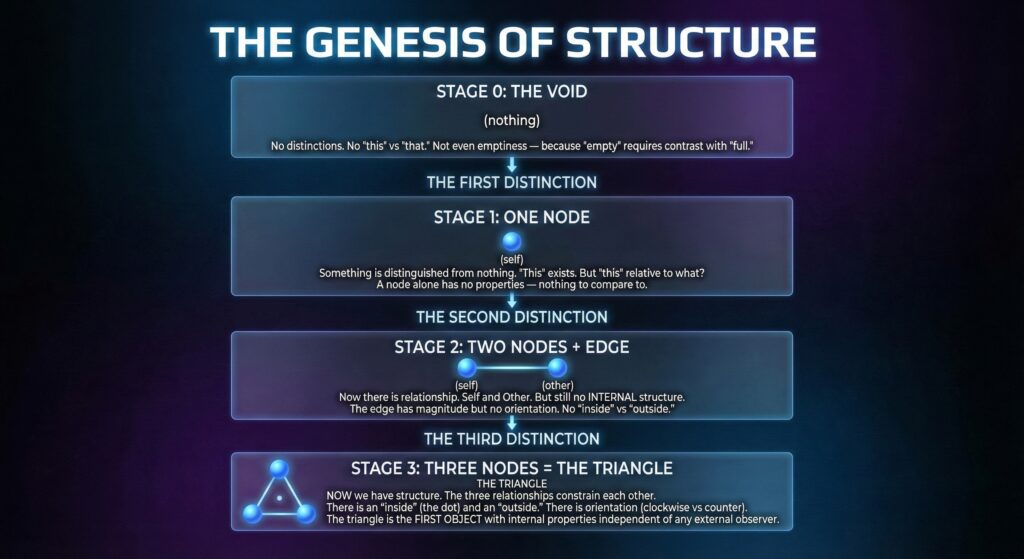
The triangle is not three things. It is the third distinction.
The first distinction creates “something.” The second creates “relationship.” The third creates structure — and with structure comes everything: orientation, area, rigidity, and eventually, physics.
This is why we start here. Not because triangles are “simple shapes,” but because the triangle is the smallest rigid framework in 2D bar-and-joint mechanics. That is the precise mathematical claim. The philosophical claim — that the triangle is a “minimum unit of sense” — is a motivating metaphor, not a theorem.
Two Approaches
Approach 1: Axiomatic (Hilbert)
Points, lines, and planes are undefined primitives. We do not say what they ARE. We only say how they RELATE.
From Hilbert’s Foundations of Geometry (1899):
“One must be able to say at all times — instead of points, straight lines, and planes — tables, chairs, and beer mugs.”
The axioms constrain relationships. The words “point” and “line” are placeholders. This is rigorous but unsatisfying — it doesn’t tell us what geometry IS, only how it behaves.
Approach 2: Relational (Leibniz, Rovelli)
There is no background space. Only relationships exist.
A “point” is not a thing. It is a label for a node in a relationship structure. The relationships are primary. The nodes are derived.
In this view:
- The triangle is not “three points in space”
- The triangle IS a primitive relationship structure
- “Points” are what we call the vertices of that relationship
- “Space” emerges from many such relationships
This is the approach we will take. It is motivated — not logically entailed — by ideas from:
- General relativity (no fixed background, geometry is dynamical)
- Loop quantum gravity (spacetime from spin networks)
- Relational quantum mechanics (no absolute state, only correlations)
Precision note. The relational stance is a choice of foundation, not a proven fact. Triangle rigidity is a theorem of Euclidean geometry that depends on the Euclidean metric. We do not derive the metric from triangles here — we assume it and explore consequences. Whether metric structure can itself emerge from relational data is an open research question (see Regge calculus, causal sets).
Why Triangles Are Rigid
Nature is Lazy, But Likes to Be Certain
Here is a principle you can carry through 1,024 lessons:
The universe minimizes effort while maximizing constraint.
This sounds like a contradiction. It is not. Consider:
- A ball rolls downhill (minimizes potential energy)
- But it settles into a valley (a constrained, stable state)
- Light takes the fastest path (minimizes time)
- But that path is uniquely determined (no ambiguity)
The square is uncertain. Given four equal edge lengths, you cannot determine the shape — it could be a square, a rhombus, a collapsed line. The universe would have to “carry extra information” to specify which.
The triangle is certain. Given three edge lengths (satisfying the triangle inequality), there is exactly ONE shape up to Euclidean isometries (translation, rotation, and reflection). No extra information needed.
The Rigidity Formula
For a generic planar bar-and-joint framework (no special symmetries, no collinear vertices), a polygon with N sides has N − 3 internal degrees of freedom. Only when N = 3 do we get zero — perfect rigidity.
Precision note. This count assumes generic position (Laman’s theorem conditions). Degenerate configurations — such as collinear vertices or special symmetries — can change the count. The triangle is rigid in 2D; in d dimensions, the minimal rigid simplex has d + 1 vertices (tetrahedron in 3D, etc.).
| Structure | Nodes | Edges | Internal DOF | Status |
|---|---|---|---|---|
| Point | 1 | 0 | 0 | Ghostly (no relation) |
| Edge | 2 | 1 | 0 | Stiff but “flat” (no area) |
| Triangle | 3 | 3 | 0 (locked) | The Atom of Geometry |
| Square | 4 | 4 | 1 (the “wobble”) | Unstable / composite |
| Pentagon | 5 | 5 | 2 | Even more unstable |
| N-gon | N | N | N – 3 | Must triangulate to stabilize |
WHY N - 3?  (The Coordinate-Counting Derivation)

Start: N vertices in the plane
       Each vertex has (x, y) coordinates
       Total coordinates: 2N

Remove rigid motions (these don't change shape):
       - 2 translations (shift left/right, up/down)
       - 1 rotation (spin around any point)
       Remaining: 2N - 3

Apply constraints (fixed edge lengths):
       - N edges, each with fixed length = N constraints
       Remaining: (2N - 3) - N = N - 3

Result:
       N = 3 (triangle):  3 - 3 = 0 DOF  → RIGID
       N = 4 (square):    4 - 3 = 1 DOF  → WOBBLY
       N = 5 (pentagon):  5 - 3 = 2 DOF  → VERY WOBBLY
This is why everything gets triangulated:
- FEM meshes
- 3D graphics
- Bridge trusses
- Geodesic domes
- Spacetime itself (Regge calculus)
The Square Cannot Hold Its Shape
SQUARE DEFORMATION — same edge lengths, different shapes:

    A ——— B           A ——— B              A—————B
    |     |            \   /                \   /
    |     |    →→→      \ /        →→→       \ /
    |     |              X                    X
    D ——— C            /   \                /   \
                      D ——— C              D     C

   [square]          [rhombus]           [collapsed]

All three have identical edge lengths |AB| = |BC| = |CD| = |DA|.
The shape is NOT determined. One internal degree of freedom remains.
Now take three nodes:
    A
   / \
  B———C
This cannot deform without breaking a relationship. The three relationships mutually constrain to a unique structure.
THE FIX — triangulate the square:

    A ——— B              A ——— B
    |     |              |\\    |
    |     |    →→→       | \\   |         Now rigid!
    |     |              |  \\  |         One diagonal = two triangles.
    D ——— C              D ——— C

One diagonal creates two triangles: ABD and BCD.
Each triangle is rigid → the whole structure is rigid.
Rigidity is not about “strength of material.” It is about informational constraint. Three relationships lock each other.
The Law of Cosines: Defining the Turn
In standard geometry, we learn the Law of Cosines as a way to find a side. Here, we use it to define the turn.
If we have three relationship magnitudes a, b, c, the “Turn” (angle θ) at node B is calculated from the tension between the three relationships:
$$b^2 = a^2 + c^2 – 2ac \cos(\theta_B)$$
Rearranging for the turn:
$$\cos(\theta_B) = \frac{a^2 + c^2 – b^2}{2ac}$$
| If… | Then cos(θ) = | The turn is… | Meaning |
|---|---|---|---|
| b² = a² + c² | 0 | exactly 90° | Relationships are orthogonal |
| b is small | positive, large | sharp (< 90°) | Nodes A and C are “pulled together” |
| b is large | negative | wide (> 90°) | Structure is “flattening out” |
| b = a + c | -1 | 180° (flat) | No turn at all — degenerate |
The angle is not measured — it is computed:
        A
       /|\
      / | \
   c /  |θ \ b          θ_A = arccos((b² + c² - a²) / 2bc)
    /   |B  \           θ_B = arccos((a² + c² - b²) / 2ac)
   /    |    \          θ_C = arccos((a² + b² - c²) / 2ab)
  B ————+———— C
        a

No protractor. Only a ruler.
The angles are implicit in the edge lengths.
The Dot Product: Measuring Overlap
The dot product measures alignment between relationships:
$$\mathbf{u} \cdot \mathbf{v} = |\mathbf{u}||\mathbf{v}|\cos(\theta_B) = ac\cos(\theta_B)$$
OVERLAP INTERPRETATION:

Positive overlap (acute):       Zero overlap (right):       Negative overlap (obtuse):

      A                              A                              A
     /                              |                                \
    / θ < 90°                       | θ = 90°                   θ > 90°\
   B ———→ C                        B ———→ C                    B ———————→ C

u·v > 0                          u·v = 0                       u·v < 0
"Working together"               "Independent"                 "Working against"
The Cross Product: The Emergence of Area
A line (2 nodes) has length but occupies zero “room.”
A triangle (3 nodes) creates a surface.
The area of the triangle:
$$\text{Area} = \frac{1}{2}ac\sin(\theta_B)$$
Or using Heron’s formula (edges only, no angles):
$$s = \frac{a + b + c}{2}$$
$$\text{Area} = \sqrt{s(s-a)(s-b)(s-c)}$$
The “Turn” is the engine that converts 1D lengths into 2D space.
The Angle Sum: Flatness as a Constraint
In a flat plane, the three turns of a triangle always add up to π (180°):
$$\theta_A + \theta_B + \theta_C = \pi$$
This is derived from the constraint structure of Euclidean geometry. The triangle being closed on a flat surface forces this.
When the Math Fails: Curvature
What if the angles DON’T add up to π?
| Angle Sum | Geometry | Curvature | Physical Example |
|---|---|---|---|
| = π | Flat (Euclidean) | Zero | A table top |
| > π | Spherical | Positive | Earth’s surface |
| < π | Hyperbolic | Negative | A saddle, a Pringle |
The angle deficit (or excess) IS the curvature:
$$\text{Curvature} \propto (\theta_A + \theta_B + \theta_C) – \pi$$
The Punchline: General Relativity
We don’t need “curved space” as a background. We only need to measure the three “Turns” in our triangle.
If they don’t add up to π, the triangle has created curvature.
In Regge calculus, discrete curvature is measured by angle deficits around simplices. This is the discrete analogue of Ricci curvature, not the full Einstein equation — the stress-energy coupling and Einstein tensor are additional structure.
Mass-energy tells spacetime how to curve. In Regge’s formulation, curvature is encoded in angle deficits. The triangle — our humble three-node structure — is the probe that detects curvature, though the full gravitational dynamics require the Einstein-Regge action, not deficit angles alone.
Summary
We do not start with space and put triangles in it.
We start with the triangle as a primitive relational structure. Points are nodes. Lines are relationships. Space is what emerges when many triangles share structure.
This is not idle philosophy — it is motivated by the structure of background-independent physics, from general relativity to quantum gravity. Whether it is the foundation required or merely a powerful analogy is a question this course will progressively sharpen.
The triangle is not IN reality. The triangle is the shape OF reality. (This is the motivating conjecture of the course, not its conclusion.)
Precision Notes
- Euclidean assumption. All results in this lesson assume flat (Euclidean) geometry. The parallel postulate is in effect. Deviations are addressed in the curvature section.
- Rigid bars model. When we say “rigid,” we assume ideal rigid bars with frictionless joints. Real materials flex. Rigidity here is informational, not material.
- Triangle inequality. Requires strictly positive side lengths. Degenerate cases (a = b + c) give zero area.
- Relational stance. The relational approach is a choice of foundation, not a proven fact about the universe. It is motivated by general relativity and loop quantum gravity but is not itself a theorem.
Exercises
1) Verify that the triple (5, 12, 13) satisfies the triangle inequality, compute all three angles, and confirm this is a right triangle.
2) Compute the area of a triangle with edges a = 7, b = 8, c = 9 using Heron’s formula.
3) Explain why a square frame collapses but a triangular frame does not, using the N − 3 formula.
4) Draw a quadrilateral with all edges = 5, in two distinct configurations. State the internal DOF.
5) Calculate the angle deficit for a triangle on a sphere where θ_A = 90°, θ_B = 90°, θ_C = 90°. What does this tell you about the curvature?
6) Prove that for any triangle, the angle opposite the longest side is the largest angle. (Hint: use the Law of Cosines.)
Key Definitions
| Term | Definition |
|---|---|
| Node | A primitive element of a relationship structure. No intrinsic properties except identity. |
| Relationship | A connection between two nodes. May have magnitude (strength/weight). |
| Triangle | Three nodes with three mutual relationships. In a simple undirected graph: the 3-cycle ($C_3$), the smallest cycle. In planar rigidity: the smallest minimally rigid framework. |
| Distinction | The act of separating one thing from another. The most primitive operation. |
| Closure | A path that returns to its starting node. Creates inside/outside and orientation. |
| Degree of freedom (DOF) | An independent parameter that can vary. N-gon has N − 3 internal DOF. |
| Point | The name for a node when we interpret the structure geometrically. |
| Space | The emergent structure of many triangles sharing nodes and relationships. |
Physics Anchor
Regge calculus: In Tullio Regge’s discrete formulation of general relativity (1961), spacetime is triangulated into simplices. Curvature lives on edges as deficit angles. Einstein’s field equations become conditions on edge lengths. No coordinates. No metric tensor. Just triangles — exactly the relational approach developed in this lesson.
References
- Hilbert, D. (1899). Foundations of Geometry
- Rovelli, C. (2004). Quantum Gravity, Ch. 2: General Relativity (relational interpretation)
- Barbour, J. (1999). The End of Time (relational mechanics)
- Regge, T. (1961). “General relativity without coordinates”
- Spencer-Brown, G. (1969). Laws of Form (the calculus of distinctions)
- Laman, G. (1970). “On graphs and rigidity of plane skeletal structures”
Limitations
This post is pedagogical infrastructure — Lesson 1 of a 1024-lesson course. It introduces intuitions that will be formalized later. Specifically:
- The relational stance (“points are derived, relationships are primary”) is a choice of perspective, not a consequence of triangle rigidity. The formal justification requires Regge calculus (Lessons 8–12) and the Cayley-Menger determinant (Lesson 15).
- The DOF argument assumes generic position and planar embedding. The full treatment of Laman’s theorem appears in Lesson 8.
- The curvature section gives the intuition for Regge calculus, not the derivation. The Einstein-Regge action is introduced in Lesson 12.
Pre-Publication Checklist
| Question | Status |
|---|---|
| Category defined? | ✅ Generic planar Euclidean bar-and-joint frameworks |
| Assumptions stated? | ✅ Euclidean metric, generic position, 2D embedding |
| Generic vs degenerate distinguished? | ✅ Laman conditions noted in precision notes |
| Fact vs interpretation separated? | ✅ Mathematical claims vs motivating conjectures labeled |
| Necessity vs sufficiency? | ✅ “Motivates” not “proves” throughout |
This is Lesson 1, Parts I–IV of the “Triangles to Everything” course — ~100 micro-sections per lesson, each 5–6 minutes, teaching physics from the triangle up. Next: [Triangles and Information]({{< ref “triangles-and-information” >}}) (Parts V–VI). The full course begins in April 2026 and is a 1024-Lesson course, each lesson 100 sections, covering “Everything!”