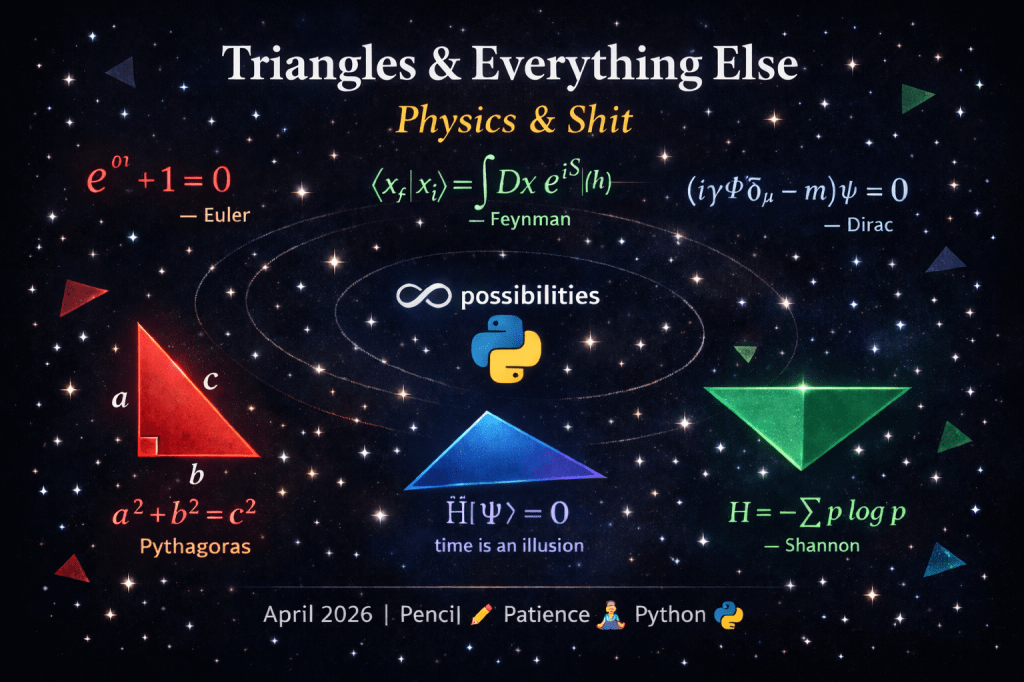
Course: Triangles & Everything Else — Physics & Shit
Start Date: 01 April 2026
Total Lectures: 54
Total Hours: ~76
Last Updated: 29 December 2025
Part I: The Triangle as Foundation
| # | Lecture | Hours |
|---|---|---|
| 1 | What is a Triangle? | 1.5 |
| 2 | The Isoceles Triangle as Nature’s Favorite | 1.0 |
| 3 | Ratios: How Triangles Encode Relationships | 1.5 |
| 4 | The Pythagorean Theorem as Conservation Law | 1.5 |
| 5 | The 45-45-90: Our Master Triangle | 1.0 |
| 6 | Scaling and Self-Similarity | 1.0 |
Part I Total: 6 lectures, 7.5 hours
Part II: Trigonometry as Triangle Language
| # | Lecture | Hours |
|---|---|---|
| 7 | Naming the Ratios: Sin, Cos, Tan | 1.5 |
| 8 | The Unit Circle: Infinite Triangles | 1.5 |
| 9 | Periodicity and Waves | 1.0 |
Part II Total: 3 lectures, 4.0 hours
Part III: Probability and Information
| # | Lecture | Hours |
|---|---|---|
| 10 | Probability from Triangles | 1.5 |
| 11 | The Binary Tree as Nested Triangles | 1.5 |
| 12 | Claude Shannon: Information as Surprise | 1.5 |
| 13 | Distributions: Where Probability Lives | 1.5 |
| 14 | Conditional Probability and Bayes | 1.5 |
Part III Total: 5 lectures, 7.5 hours
Part IV: The Complex Plane
| # | Lecture | Hours |
|---|---|---|
| 15 | What is √(-1)? | 1.5 |
| 16 | Complex Numbers as Triangles | 1.0 |
| 17 | Multiplication as Rotation + Scaling | 1.5 |
| 18 | Euler’s Identity: The Triangle Equation | 1.5 |
Part IV Total: 4 lectures, 5.5 hours
Part V: Calculus Through Triangles
| # | Lecture | Hours |
|---|---|---|
| 19 | Slope as Triangle | 1.0 |
| 20 | Derivatives of Sin and Cos | 1.5 |
| 21 | Area as Sum of Triangles | 1.5 |
| 22 | The Fundamental Theorem | 1.0 |
Part V Total: 4 lectures, 5.0 hours
Part VI: Vectors and Linear Algebra
| # | Lecture | Hours |
|---|---|---|
| 23 | Vectors: Arrows from Triangles | 1.0 |
| 24 | Dot Product as Projection | 1.5 |
| 25 | Matrices: What They Do to Triangles | 1.5 |
| 26 | Eigenvalues: Triangles That Don’t Rotate | 1.5 |
| 27 | Inner Products in Abstract Spaces | 1.0 |
Part VI Total: 5 lectures, 6.5 hours
Part VII: Classical Mechanics — The Action Triangle
| # | Lecture | Hours |
|---|---|---|
| 28 | Newton: Forces as Vectors | 1.5 |
| 29 | Energy: A Better Bookkeeping | 1.5 |
| 30 | Lagrange: The Action Principle | 1.5 |
| 31 | Hamilton: Phase Space | 1.5 |
| 32 | Poisson Brackets: The Classical Commutator | 1.5 |
| 33 | Action as Geometry | 1.5 |
Part VII Total: 6 lectures, 9.0 hours
Part VIII: Statistical Mechanics — Triangles in Crowds
| # | Lecture | Hours |
|---|---|---|
| 34 | From One to Many: Ensembles | 1.5 |
| 35 | Boltzmann: Probability from Energy | 1.5 |
| 36 | Entropy: Counting Triangles | 1.5 |
| 37 | The Bridge to Quantum Statistics | 1.0 |
Part VIII Total: 4 lectures, 5.5 hours
Part IX: Symmetry and Groups
| # | Lecture | Hours |
|---|---|---|
| 38 | Symmetry Operations | 1.5 |
| 39 | Groups: The Algebra of Symmetry | 1.5 |
| 40 | Noether’s Theorem: Symmetry = Conservation | 1.5 |
Part IX Total: 3 lectures, 4.5 hours
Part X: Quantum Mechanics
| # | Lecture | Hours |
|---|---|---|
| 41 | State Vectors and Superposition | 1.5 |
| 42 | Measurement as Projection | 1.5 |
| 43 | Operators and Observables | 1.5 |
| 44 | The Hamiltonian: Energy as Operator | 1.5 |
| 45 | Schrödinger’s Equation | 1.5 |
| 46 | The Uncertainty Principle | 1.5 |
Part X Total: 6 lectures, 9.0 hours
Part XI: Quantum Action and Path Integrals
| # | Lecture | Hours |
|---|---|---|
| 47 | Feynman’s Sum Over Histories | 1.5 |
| 48 | The Path Integral | 1.5 |
Part XI Total: 2 lectures, 3.0 hours
Part XII: Applications
| # | Lecture | Hours |
|---|---|---|
| 49 | The Hydrogen Atom from Triangles | 1.5 |
| 50 | Building Molecules and Stars | 1.5 |
Part XII Total: 2 lectures, 3.0 hours
Part XIII: Frontiers — Where Triangles Meet Reality
| # | Lecture | Hours |
|---|---|---|
| 51 | Quantum Information and the Qubit | 1.5 |
| 52 | Quantum Gravity: Spacetime from Triangles | 1.5 |
| 53 | Epistemology in Hilbert Space: Belief, Truth, and Lies | 2.0 |
| 54 | Time, Nothingness, and Wheeler’s Final Triangle | 1.5 |
Part XIII Total: 4 lectures, 6.5 hours
Summary
| Part | Title | Lectures | Hours |
|---|---|---|---|
| I | The Triangle as Foundation | 6 | 7.5 |
| II | Trigonometry as Triangle Language | 3 | 4.0 |
| III | Probability and Information | 5 | 7.5 |
| IV | The Complex Plane | 4 | 5.5 |
| V | Calculus Through Triangles | 4 | 5.0 |
| VI | Vectors and Linear Algebra | 5 | 6.5 |
| VII | Classical Mechanics | 6 | 9.0 |
| VIII | Statistical Mechanics | 4 | 5.5 |
| IX | Symmetry and Groups | 3 | 4.5 |
| X | Quantum Mechanics | 6 | 9.0 |
| XI | Quantum Action | 2 | 3.0 |
| XII | Applications | 2 | 3.0 |
| XIII | Frontiers | 4 | 6.5 |
| Total | 54 | ~76 |
Prerequisites
None. This course starts from zero.
Required Materials
- Notebook (physical, for hand-drawing triangles)
- Python environment (numpy, scipy, matplotlib, sympy)
- Jupyter notebooks (provided)
Grading
Just study this shit at your own pace. If you need help, then ask for help. He who needs help and is silent is either dead or a dumbass.
The Triangle Principle
The triangle is the minimal structure that encodes relationship. Two points define a line. Three points define a plane, with distances, angles, orientation, and area. This is enough to build probability, information, complex numbers, vectors, action, quantum states, spacetime, and epistemology.

 ooutwire ideas
Leave a comment